Christian — Two surfaces, one truth
Morning session, continuing from yoga and Roll for Life. For the first time, Christian covers two different surfaces in a single session: first the synthetic lawn in the garden, then the hardwood floor inside. The intention: observe what the transition between surfaces reveals.
Synthetic lawn — The left side becomes easy
Left side — always the most uncomfortable on the lawn. Today, after 21 days, it is easy. The body adapts quickly, finds the right position without mobilizing the nervous system into alert mode. Contact with the floor is established. The breath does not push the ribs against the floor — it travels toward the free parts, forward, backward, upward, without gravitational resistance. The senses settle. Nothing demands particular attention.
Twenty-one days have built something silent. The left side has become accessible.
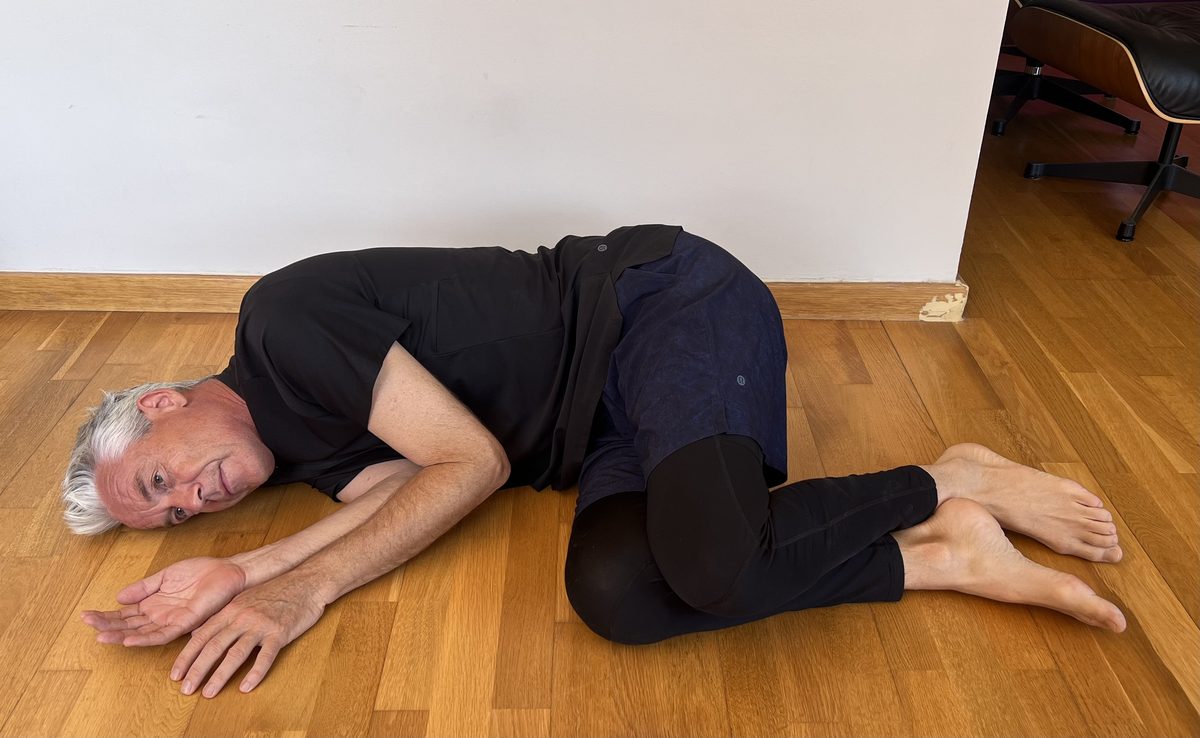
Hardwood floor — The nervous system in transit
On the hardwood, everything changes. The surface is harder. Micro-adaptations are constant. Christian observes the mechanism plainly: when the knee is uncomfortable, the nervous system goes there. It forgets everything else, tries to solve that problem. Then another part becomes uncomfortable, and the nervous system migrates. Then another still. It travels through the body until it finds a globally acceptable position.
This is observable: the nervous system does not manage the whole body at once. It concentrates on the most urgent problem, partially resolves it, then moves to the next. Global comfort is not a state — it is a permanent negotiation.
This mechanism has a direct therapeutic implication. When something is truly blocked — in the body, in memory, in the deep layers of the nervous system — confronting it directly does not work. The nervous system is wired to defend what it perceives as a threat: approach the problem and it contracts further. The inverse strategy is more effective: go to the layer beneath. Give the nervous system a different problem to solve — more superficial, more accessible — and divert its attention away from its guard function. Once it is occupied elsewhere, once it has released its vigilance over the problematic layer, what was truly blocked can free itself. Not because it was forced, but because it was no longer being signaled that it needed protection.
The meditative state — Not giving it a problem to solve
From this emerges a clear understanding of what the meditative state actually is. It is not a technique. It is not a particular concentration on an object or a thought. It is this: leaving the nervous system in peace — not giving it a problem to solve.
When the body is comfortable enough that the nervous system is not on alert, something is freed. One exits the problem-solving body. What yoga calls Chitta — pure consciousness — is not a state to reach. It is what remains when the alerts fall silent.
The mind that covers the mind
What Christian also observes is the ordinary strategy in the face of bodily discomfort: the mind tries to resolve, then covers itself with a new mental layer, then another. If I had that, if I went there, if I had that house, that car, that trip — mental comfort is sporadic, always conditional, always projected toward something still missing.
Yet the body does not lie. When you are not well in your body, you are not well. The mind can lay a layer of I am fine over an exhausted or painful body — that doesn't change the body's state. The body is the only evaluation that is true.
What we take away
Twenty-one days have transformed the left side. What was most uncomfortable has become accessible — not through effort, but through silent accumulation. The body has integrated.
The nervous system handles only one problem at a time. When a zone is uncomfortable, all attention goes there. That is why a body at peace frees the mind: there is nothing left to solve. This is the condition of true rest — and of meditation.
The meditative state is not a technique — it is an absence of alert. Chitta is not to be reached. It is what remains when nothing is left to solve.
Bodily comfort is the only comfort that doesn't lie. Mental comfort is a projection. Bodily comfort is immediate, verifiable, real. This is what the 12 months are built on.
Adi — The body cleansing (continued)
Adi continues her caffeine detox. The process follows its course. No formal session — the body works at its own pace.
← Back to journal