Christian — Total collapse and sound
First session of week 4. Floor with a small yoga mat — not directly on the bare hardwood, a light layer of cushioning. Session done immediately after Shambhavi Mahamudra Kriya. Christian settled easily onto his right side and noticed something: he was no longer searching for a position. He was seeking release.
Total collapse — The body seeks on its own
Twenty-two days have changed something fundamental. Christian collapsed completely. Less and less tension. Each part of the body tries to find its place for the deepest possible letting go. It is no longer a conscious intention — the body is the one searching.
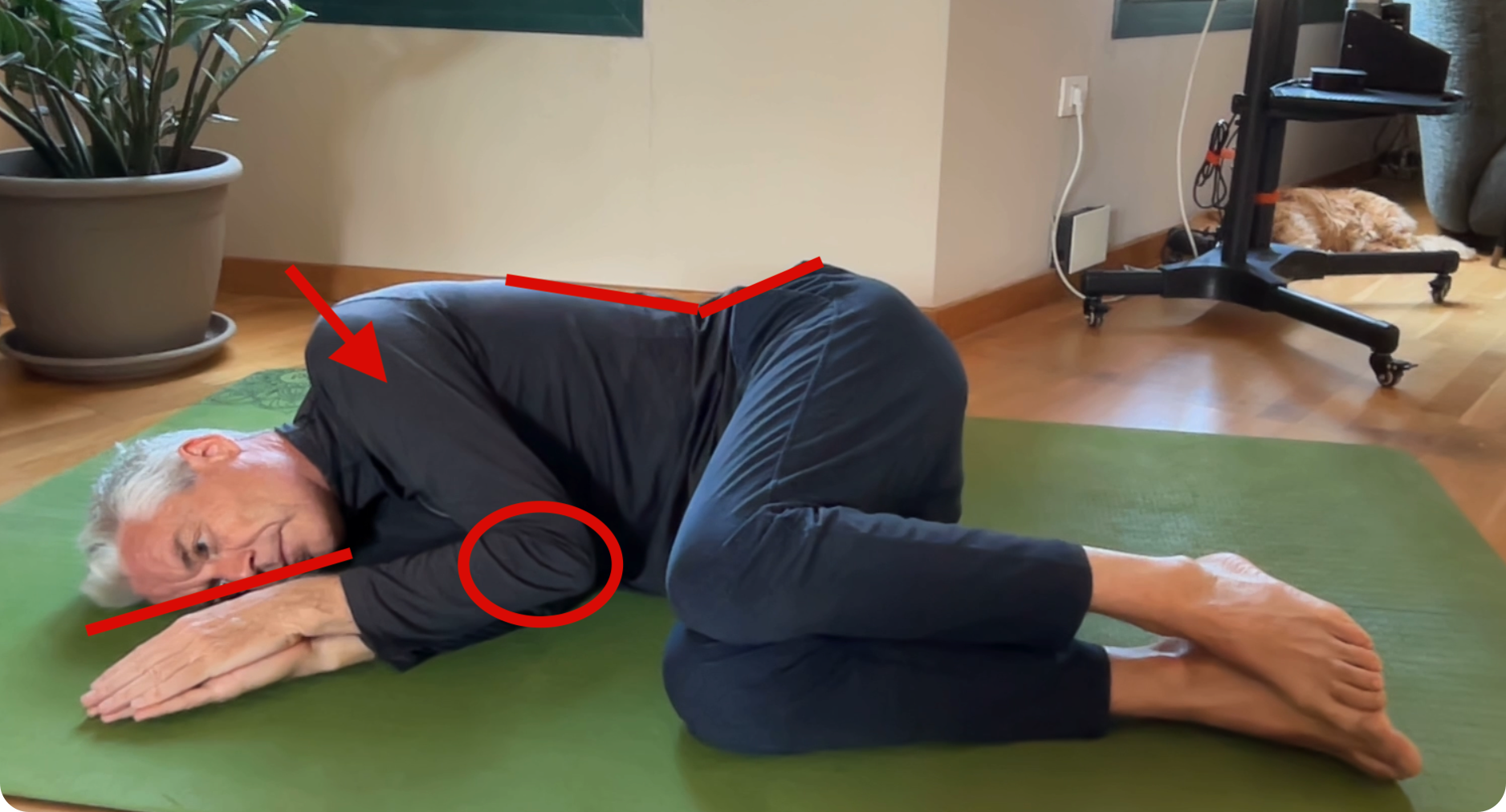
Right side: head completely to the side, ear in contact, chin in contact. A new flexibility has appeared in the cervical vertebrae, the neck, the spine. Chest nearly in contact. Arms shifting position to maximize contact with the floor. Ribs. Pelvis tilting forward. Legs finding their positions. Feet with no sense of a hard edge, no tension whatsoever.
Left side — always different, always historically more uncomfortable. But here too: the same will to collapse completely. Different position from the right side: one leg straight, the arm stretched downward toward the forward knee, head in contact — cheek and ear. This did not exist at all on Day 1. The photos from the beginning make that clear.
Visual comparison — Day 3 vs Day 22
Foetal position — right side
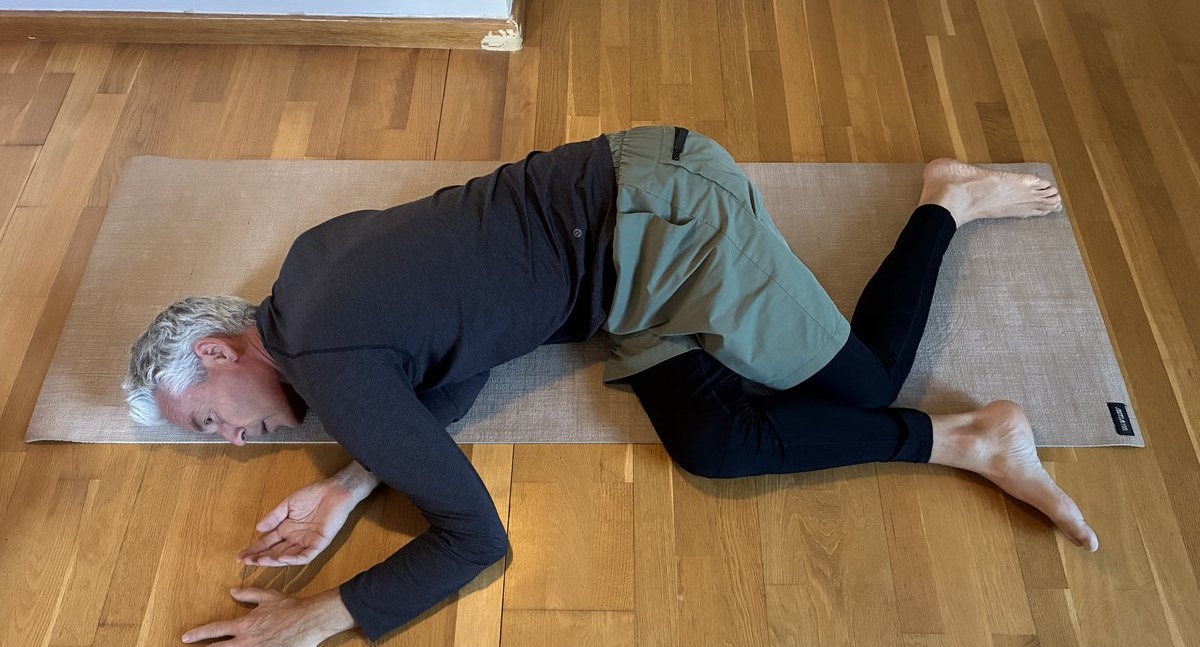
Foetal position — left side
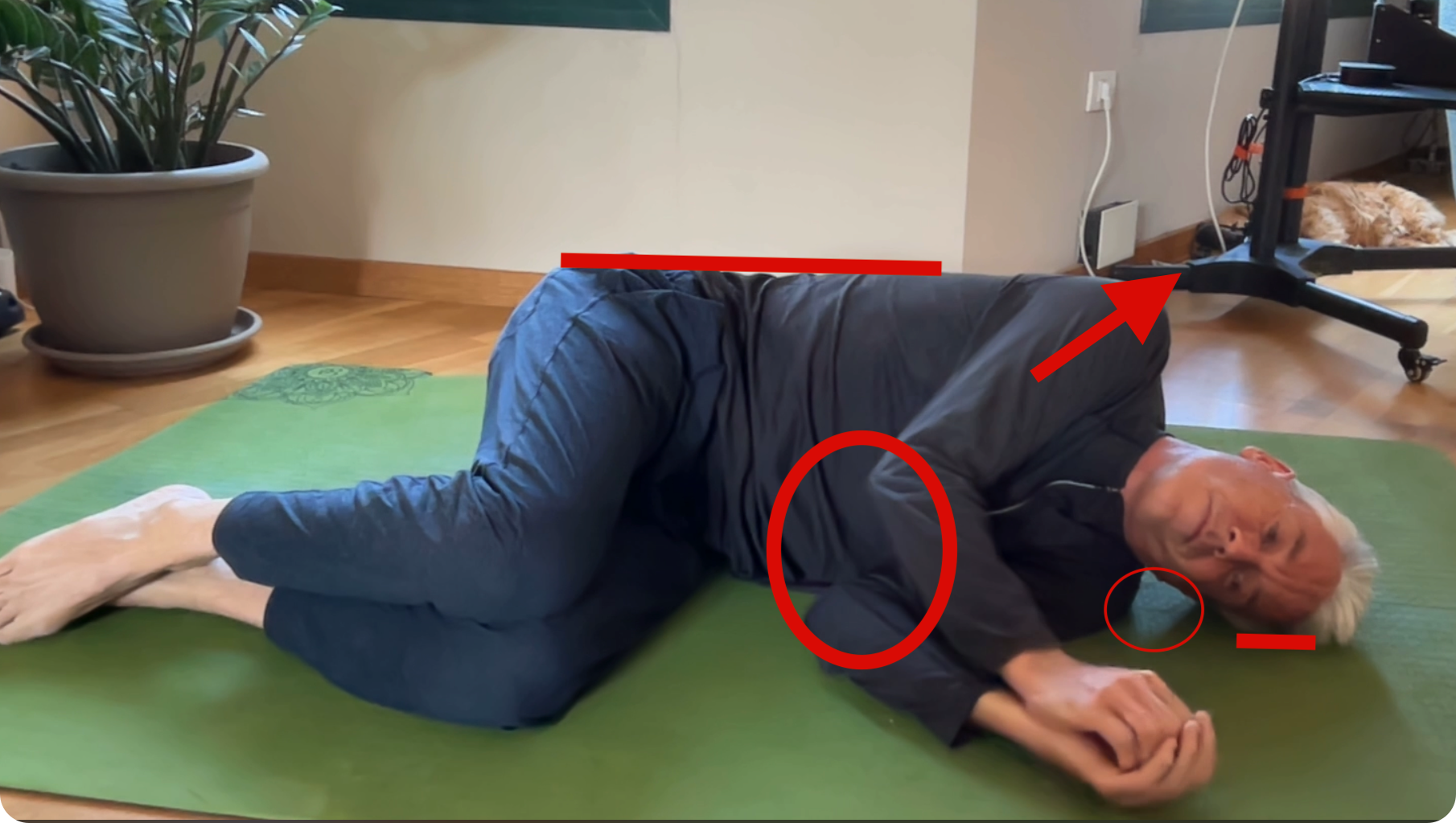
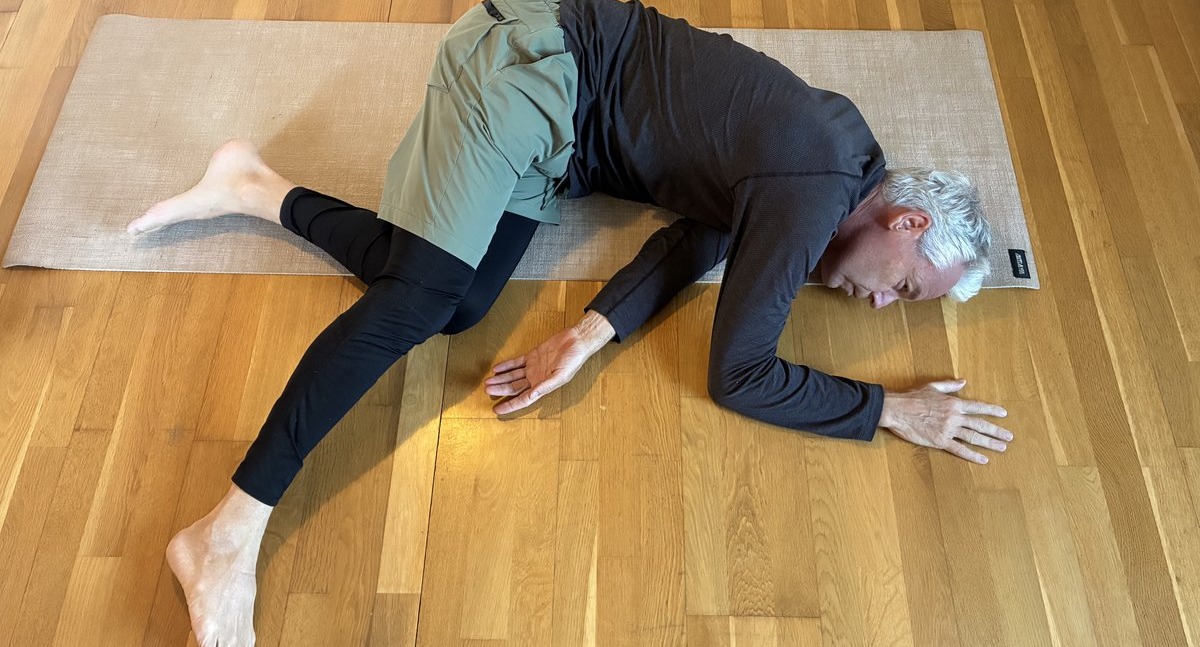
On Day 3, the body was still searching for its position: bony edges were perceptible, the left side resisted, the shoulder lifted. On Day 22, collapse is total — ear, chin, cheek in contact, pelvis tilted forward, feet without a single hard edge. Twenty-two days of silent gravity.
Shoulders twisted on both sides. But the collapse is such that there is no room left for the intellect to discriminate comfort from discomfort. The release itself neutralizes the analytical capacity. No more judgment. Just collapse.
The body without boundaries — What contact reveals
From this comes a reflection on Western civilization. We are capable of playing a role, believing in that role, being locked in a total identification with data — social, professional, identity-based. We invent our own boundaries.
But when you are on the floor, sitting or standing and try to define your actual physical boundaries, you realize that without contact with something external, it is very difficult. The body has no clear edges in empty space. It doesn't know where it ends. Contact is what gives it its boundary. Not thought. Not role. Contact.
Sound maps the body — The AOM
The same reflection arose during the Shambhavi Mahamudra Kriya that preceded the session: what are my physical boundaries, my physical contours? In chanting the "aoum", something was revealed. The vibrations of the mantra create an internal reverberation — and that reverberation maps the body from within.
Each syllable reveals a different zone. The "a" vibrates in the region of the navel. The "o" in the region of the heart — the sternum. The "m" in the throat. Sound is a form of contact with oneself — not through surface, but through resonance. It touches the boundaries that the floor alone cannot reach.
Adi — A different presence
Adi was doing Shambhavi Mahamudra Kriya at the same time as Christian. Her spontaneous remark afterward: "I felt a presence coming from you, different."
What a shared practice creates does not stay inside the practitioner.
What we take away
Collapse has become the natural, spontaneous goal. After 22 days, the body seeks maximum release on its own. It is no longer discipline — it is an inner direction.
Physical boundaries only exist through contact. Without contact, the body is borderless. This is why the position on the floor is more real than any social role: it gives a real boundary.
Sound completes what the floor begins. The AOM creates internal contact — a mapping of the body through resonance. The body that cannot be reached from the outside can be touched from the inside through vibration.
The mind invents roles. The body only knows where it is when it is touching something.
Adi — The Difficult Return
Return after approximately four days off. Adi had not been feeling well. At the same time: day four of a caffeine detox — intense headaches, pain in the legs and hip joints, crashing energy.
Like the beginning
A difficult session — like the first days. Impossible to find a comfortable position. Not on the left side, not on the right, not on the back. The pain in the legs is intense. The body wants it to end. It is not the body that has forgotten — it is the chemistry of withdrawal speaking.
Movement as the only relief
What brings relief is not stillness — it is movement. Adi feels the need to get up, to move. For weeks, lying down had become a source of comfort. Today the opposite is true: the body is in a state of internal agitation, not rest.
What we retain
The body speaks the language of chemistry. The detox creates a distinct physiological reality. The practice does not happen in a neutral body — it happens in a body in the grip of withdrawal.
Four days are enough to return to the beginning. The bodily acquisition is not lost, but the tolerance threshold has tightened. The body has unlearned ease.
"I want to find my bliss again." Adi has known a state of deep wellbeing in the practice. That word — bliss — has become an inner reference point. She now knows what she is looking for.
← Back to journal