Christian — The Weight of Release
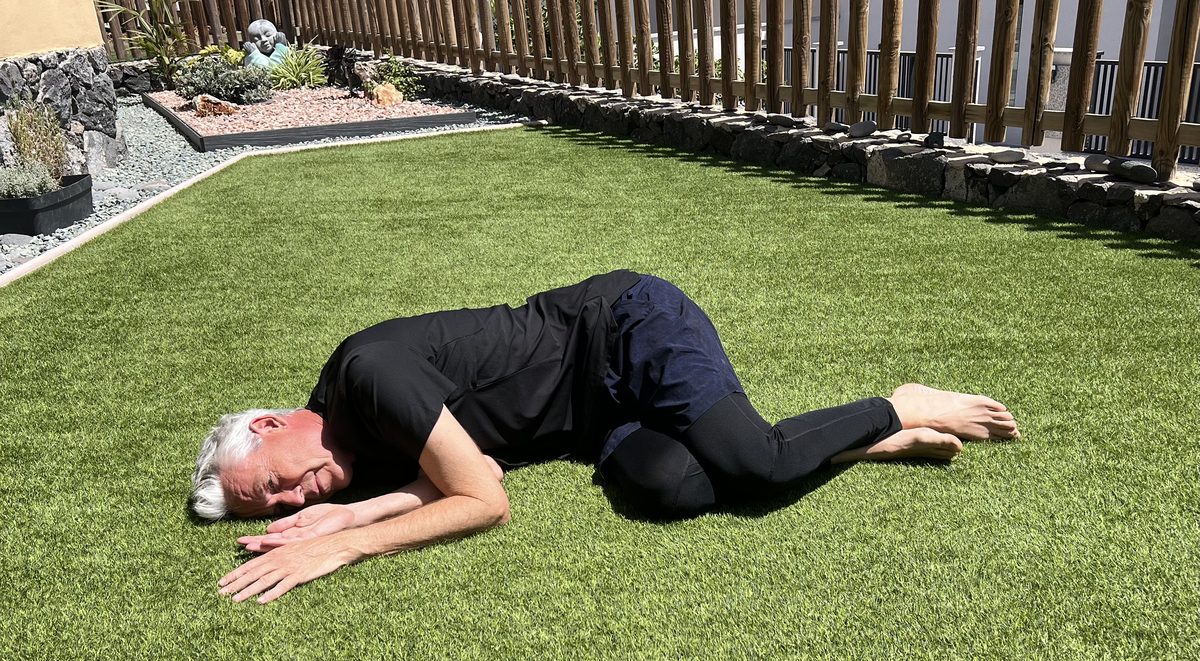
Back to the garden, the synthetic lawn. The day's intention is simple: settle down, be as little in the mind as possible, focus solely on release. Right side — no problem. The body recognizes the surface.
Scan and descent
Doing a scan from head to feet with the intention of releasing, Christian notices he sinks lower and lower with each pass, each body part. There is always something more to let go. And when the body truly releases — completely — it is very, very heavy. It takes the shape of the floor, molds itself to it, but it weighs.
This comes as a surprise. We associate release with lightness — when in fact it is the opposite. The lightness comes after — once the descent into the floor is complete. The release itself is a descent, a letting go of weight. The body, when it abandons its tensions, does not float: it weighs. It becomes what it is — matter that gravity attracts.
The permanent game
What he observes next is even more striking. When he directs attention toward a part of the body to release it, that part lets go. But as soon as he moves to another zone, a slight tension returns in the first. And when he goes back, it is not quite the same tension — but there is one. There is always a game of tensions that reorganizes, redistributes, reconfigures. Always.
The costume
From this a broader thought emerges. We often speak of tired bodies at 50-55. We imagine elderly people at 70, 80, 85: exhausted. Every 16 hours, the body must shut down for 8 hours — because the nervous system is overused. It has an incredible potential, but it is constantly called upon.
Then comes the question: if we remove everything — the mind, the life stories, being a father, working on television, the successes and failures — what remains? Christian believes what remains is the first 12 months. That founding preparation — the neural circuits, the patterns of tension and release, the foundational relationship to the floor, to gravity, to the body. Everything else — the career, the identities, the roles — is a costume. A permanent costume that we put on and take off.
The nervous system never takes off the costume. It holds tensions, accumulates, compensates. It is very exhausting.
What we take away
Complete release means heaviness — not lightness. When muscular tensions fall, the body does not float: it weighs. Gravity does its work. What we interpret as lightness after a session is the contrast with before — not the state itself. The state itself is a descent.
The nervous system never reaches equilibrium — it approaches it. As soon as one zone releases, another takes over. This game of tensions is not a sign of failure: it is the nature of the system. The baby lives this too — but without a story around it. The adult carries a narrative about every tension.
When you remove everything, the first 12 months remain. The costumes — career, roles, identities — accumulate on a foundation. That foundation is what was built between birth and the twelfth month. If that foundation is solid, the costumes do not weigh too much. If it is fragile, everything weighs — including rest.
Working the body lightens the mind. After a year of daily practice, mental health is lighter. Not because thoughts have changed — but because the body makes less noise. Less bodily noise, more mental space.
Adi — The body cleansing (continued)
Adi is still in the caffeine detox phase. The body is going through every stage — sometimes intense, but in the right direction. The fixations are leaving. This is not a setback: it is the same process as the floor, as the session, as the release — the body returning to itself, at its own pace. Patience and trust in the process.
← Back to journal