The night before, a boat moored in the harbour. The rocking of the night inscribed itself in the body. Today, back on the floor — and the memory of the waves transforms into something unexpected.
Christian — When rocking becomes a cradle
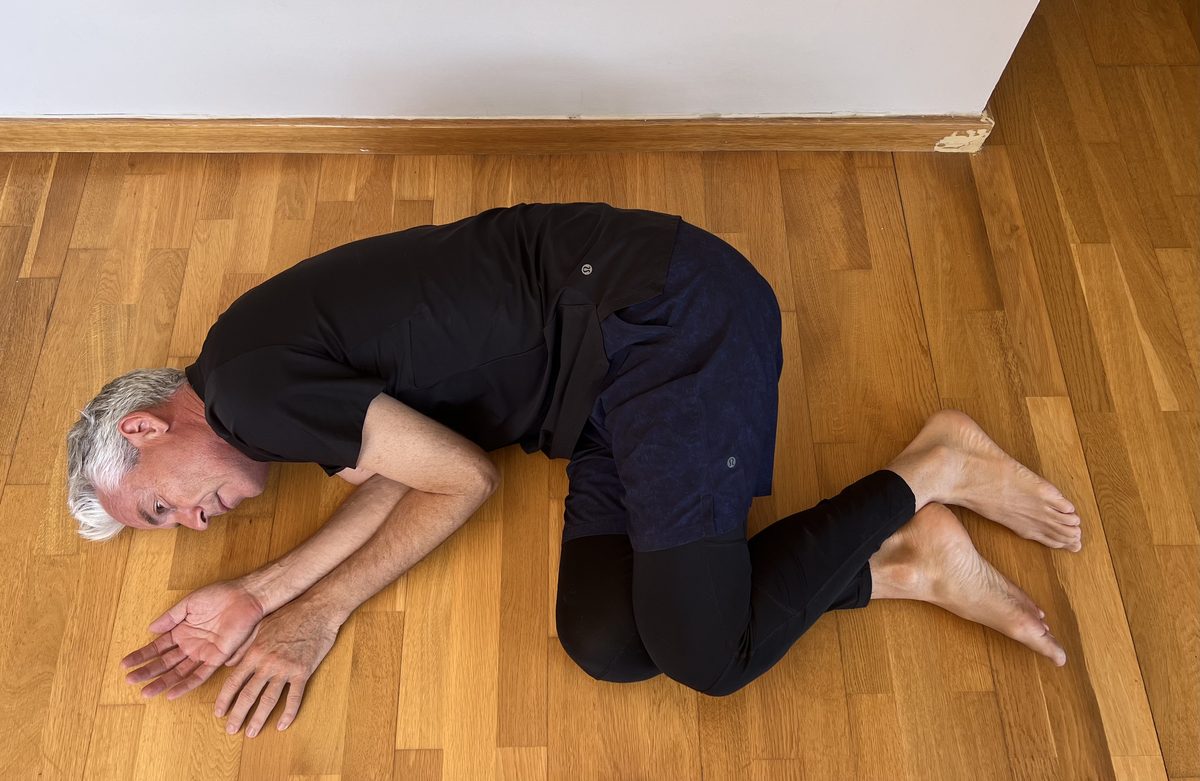
Right side, returning to the floor after yesterday's sofa takes time. The body has known comfort — coming back to hardness demands renegotiation. Gradually, the position is found. The knees remain uncomfortable — the same inner edges. But the breath settles into the belly. Opening the eyes, the dog is lying opposite, on the same side, completely released. The living mirror of letting go.
Left side, the usual ordeal. Edges everywhere — outer and inner. As if the body were resting on sticks. No surface, just lines of pressure. The breath stays in the ribs and upper body.
Then the shift. Eyes close. Instead of focusing on the discomfort, the body seeks a meditative state. And the boat's rocking from the night before returns — but transformed. It is not nausea. It is the sensation of a baby in a cradle being rocked from side to side to fall asleep. A feeling of satisfaction, not discomfort. The body has taken yesterday's rocking and translated it into the oldest language it knows: being cradled. The discomfort vanishes. The meditative state settles in.
On the back, the breathing reaches unprecedented proportions. Approximately 1 to 1.5 inhale-exhale cycles per minute — one full cycle every 40 to 45 seconds. The air enters and keeps entering — it diffuses into the ribs, the lungs, the belly. A sensation of volume growing, never in suppression, always in expansion. The head is centred for the first time — no longer leaning left. The weight is above the nose. The hollow in the lower back has decreased. The ten minutes pass very, very quickly.
Adi — From nausea to sleep
Morning brings nausea. The after-effect of last night's boat. The body still carries the rocking in its viscera. Second day in a row on the floor — after the Day 4 shift that changed everything. The session is done with low-frequency music — a sonic constant that envelops the space.
Left side, it takes time to find an acceptable position. Right side, it comes faster. The difference between the two sides becomes more precise: to find relative comfort, the body must turn slightly differently on each side — a rebalancing at the shoulder. On the right, the upper body and head turn slightly upward. On the left, the opposite. Both sides require a slight torso rotation for the shoulder to find its place.
The breathing has changed. Today, on both sides, the breath is in the belly and the chest. The inhalation enters the belly and extends into the ribcage. This is a clear progression from previous days, when breathing remained more localised.
On the back, very relaxing. A feeling of being much closer to the floor — the opposite of yesterday. Towards the end, she was drifting off. And after the session, she fell asleep on the floor. How long, she doesn't know. Very lethargic upon waking. The contrast is striking: the same person who was nauseous in the morning sleeps on the floor in the afternoon. The nervous system shifted from protection to total surrender.
Louella — Energy at the fingertips
Second session from Berlin. More comfortable than the first — no feeling of being crushed or below the floor. The body settles more slowly. One persistent detail: the sensation that the head is being pushed towards the floor.
Grasping reveals something new. Opening and closing the hands, a sensation of energy appears at the fingertips. It is neither tension nor pain — it is a presence. The shoulders are open. The muscles are slightly tight, with a perception of blocks in the muscular layers.
The progression from the first session is clear: more comfort, less resistance, and this energy in the hands that wasn't there before. The body is beginning to recognise the position.
What we take away
The body's memory doesn't translate — it transforms. The boat's rocking didn't stay as rocking. It became a cradling. The nervous system took a recent experience (the waves) and translated it into an older pattern (the cradle). This is not a conscious memory — it is a sensory restitution that passes through the body. This is exactly what a baby does: every experience is stored not as a fact but as a sensation, and that sensation recombines with others to create new states.
One inhale-exhale cycle every 40-45 seconds. Normal resting rate is 12 to 20 cycles per minute. Christian is at 1.5. That's not a breathing technique — nobody decides to breathe that slowly. It happens when the dorsal position removes all postural demand: no muscles holding the body up, no balance to maintain, no effort anywhere. The diaphragm moves on its own schedule. The inhale fills without intention, the exhale empties without control. The autonomic nervous system runs the show. The person is no longer breathing — the body is.
Adi's contrast. Nausea in the morning, sleep on the floor in the afternoon. The same body, the same day, two opposite states. The session didn't cure the nausea — it allowed the nervous system to shift from protection mode to trust mode. The low-frequency music, the floor, and five days of accumulation created the conditions. Falling asleep on the floor after the session is the clearest signal that identity has let go.
Louella's energy. Grasping produces a meditative state in Christian, respiratory expansion in Adi, and now an energy sensation at the fingertips in Louella. Three bodies, three different responses to the same exercise — but the mechanism is identical: focusing attention on the hands frees the rest of the system.
← Back to journal