You don't always place a baby in the same spot. Floor, crib, sofa, parent's arms — each surface tells a different story to the nervous system. Today, we switch everything. Christian goes to the sofa. Adi goes to the floor.
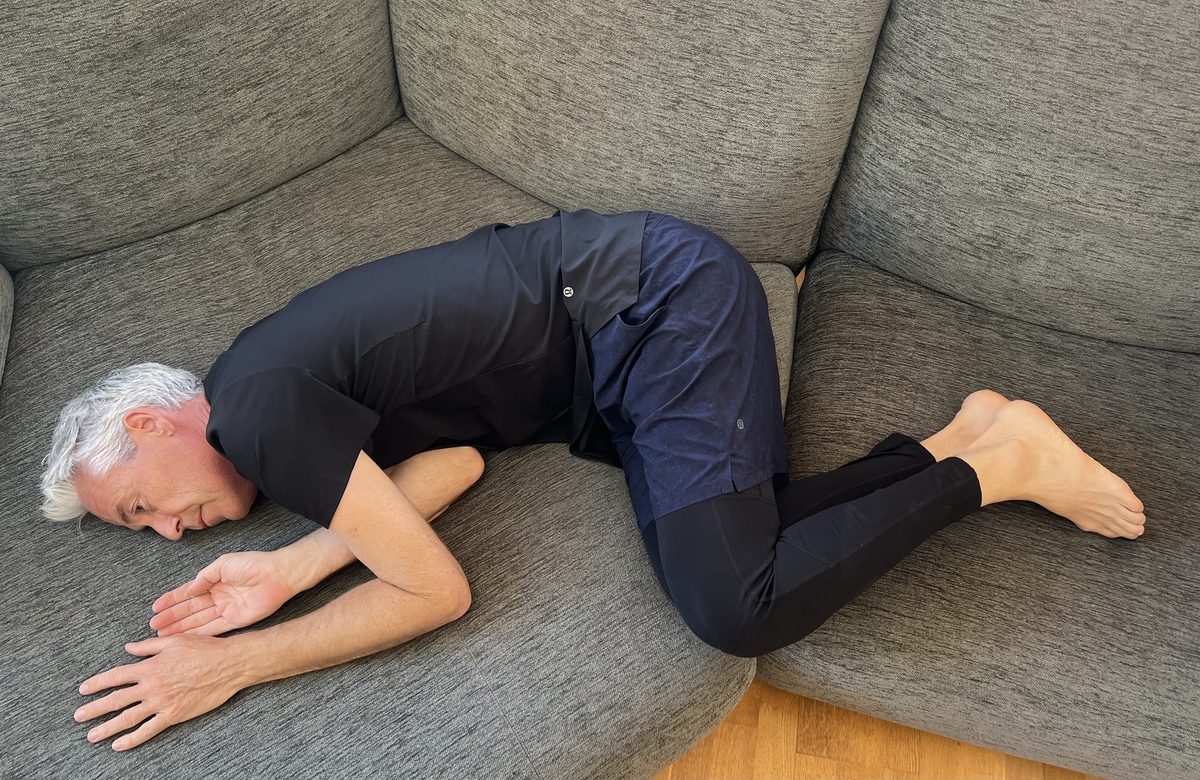
Christian — The sofa that absorbs
Right side in the sofa: extremely comfortable. A wide contact surface, the body settling in without searching. The only point that persists — the edge of the knees. The same as on the floor. This bone-to-bone contact doesn't depend on the surface. The body carries it.
Breathing shifts. On the floor, the belly descended toward the earth — gravity pushed it down. In the sofa, the belly hangs less. The breath stays more in the lungs. To inflate the belly, you'd need to breathe more deeply — but the baby doesn't perform breathing. It takes what the surface gives.
Left side: the surprise. Much, much more comfortable than on the floor. The left side in the sofa reaches the comfort level of the right side on the floor. The sofa compensates for what the body can't yet provide. But a nuance appears — the body falls forward. No reversibility. The support plane feels tilted. A constant slight effort not to tip over. The sofa offers comfort but removes control. It's a trade-off the baby lives every day: the parent's arms are comfortable, but you control nothing in them.
Grasping is freed. The right side is so comfortable that the nervous system has nothing left to monitor. The hands work in complete autonomy — no postural interference, no breathing variation, no tension elsewhere. Just the hands opening and closing. This is what the baby experiences when well settled: grasping costs nothing beyond grasping.
On the back, breathing is more ample than ever. The breath inflates upward, the sofa's contact wraps around the back. On the verge of sleep. But the neck still won't yield. Four days, two surfaces — and the head still holds. This isn't about comfort. It's about trust.
Adi — The floor that awakens
Three days on the sofa: sleep, nausea, resistance, the body vanishing from perception. First day on the floor: total presence. Not a single drift, not an ounce of resistance. Completely open, completely alert, from start to finish.
What changed? Everything at once. The floor instead of the sofa. The session directly after yoga and meditation, with no break. An empty stomach. An earlier hour. No single factor can be isolated. But the result is clear: the nervous system shifted from survival mode to perception mode.
The comfort difference between the two sides has nearly vanished. The main challenge now is the shoulder against the floor. On the left side, for the shoulder to find its place, the head rotates — forehead to the ground. On the right side, the head tilts differently — the top of the skull makes contact. Two different strategies for the same problem. No suffering, no escape — just the body negotiating with the surface.
And then, during grasping, something happens for the first time. On the left side, the contact with the floor — angular at first — softens. The left rib cage releases gradually. And suddenly, the breath floods the ribs. What started in the belly expands into the entire rib cage — toward the floor, toward the right side above, everywhere. A complete expansion. This is the first time since the project began that the breath hasn't stayed confined to the belly.
On the back, the floor draws a map of the body. Three precise contact points: the back of the skull, the shoulder blades, the tailbone. Between the shoulder blades and the tailbone — a great arch. The back is curved, far from the floor. But in front, the chest is open, the belly relaxed. The torso expands in every direction. No pain anywhere. No chest pressure like on the sofa. No heaviness in the head. Just the body showing itself as it is, contact point by contact point.
What we take away
The surface changes everything. Same exercise, same day, two reversed surfaces — and two opposite revelations. Christian goes to the sofa and discovers comfort: the left side becomes bearable, grasping is freed, sleep approaches. Adi goes to the floor and discovers clarity: resistance vanishes, the rib cage opens, contact points sharpen. The sofa absorbs and wraps. The floor informs and demands. Both are necessary. The baby moves from one to the other constantly — arms, crib, floor, parent's chest. The adult stays on the same surface for decades. Alternating is already unlearning a fixation.
The sequence that changes everything. Adi did the session directly after yoga and meditation, with no gap. Three days of resistance — then total presence the moment the nervous system arrives prepared. The baby doesn't need preparation — it's already in that state. The adult does. The meditation-to-developmental-exercise sequence may be the key that allows the adult nervous system to recover the availability of the newborn.
The rib cage that opens. During grasping, the angular floor contact softens and the breath invades the ribs. In Christian, grasping has produced a meditative state since Day 1. In Adi, it produces respiratory expansion. Same catalyst, two different effects — but the mechanism is identical: focusing attention on the hands frees the rest of the body.
← Back to journal