When the body starts to release, it doesn't simply become more comfortable. It reveals the next layer. The one you couldn't feel when everything was still locked.
Christian — The layer beneath
The great right/left dichotomy is still there. The right side remains the comfort zone, the left side remains hostile territory. But today, something shifts in the reading.
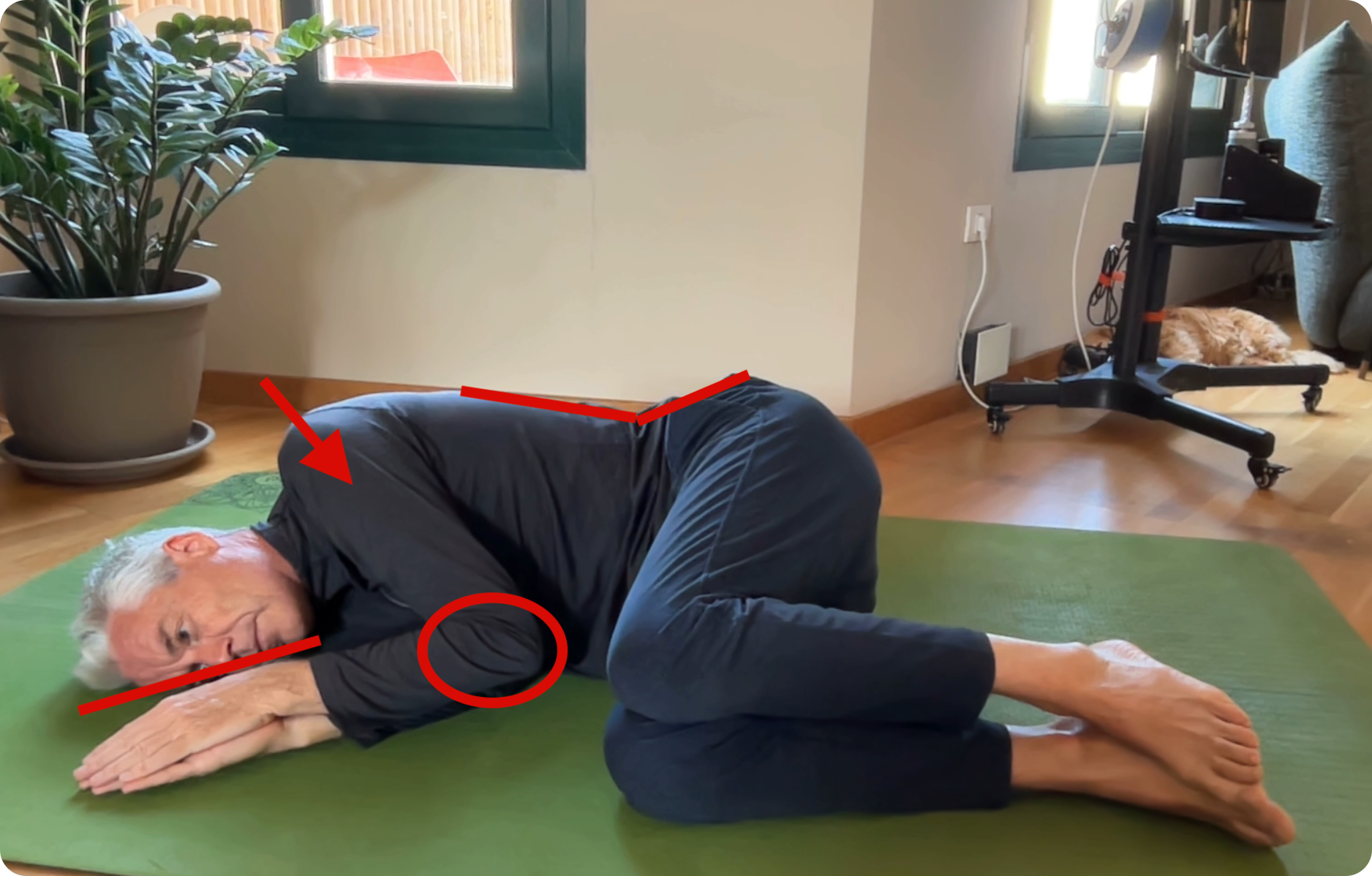
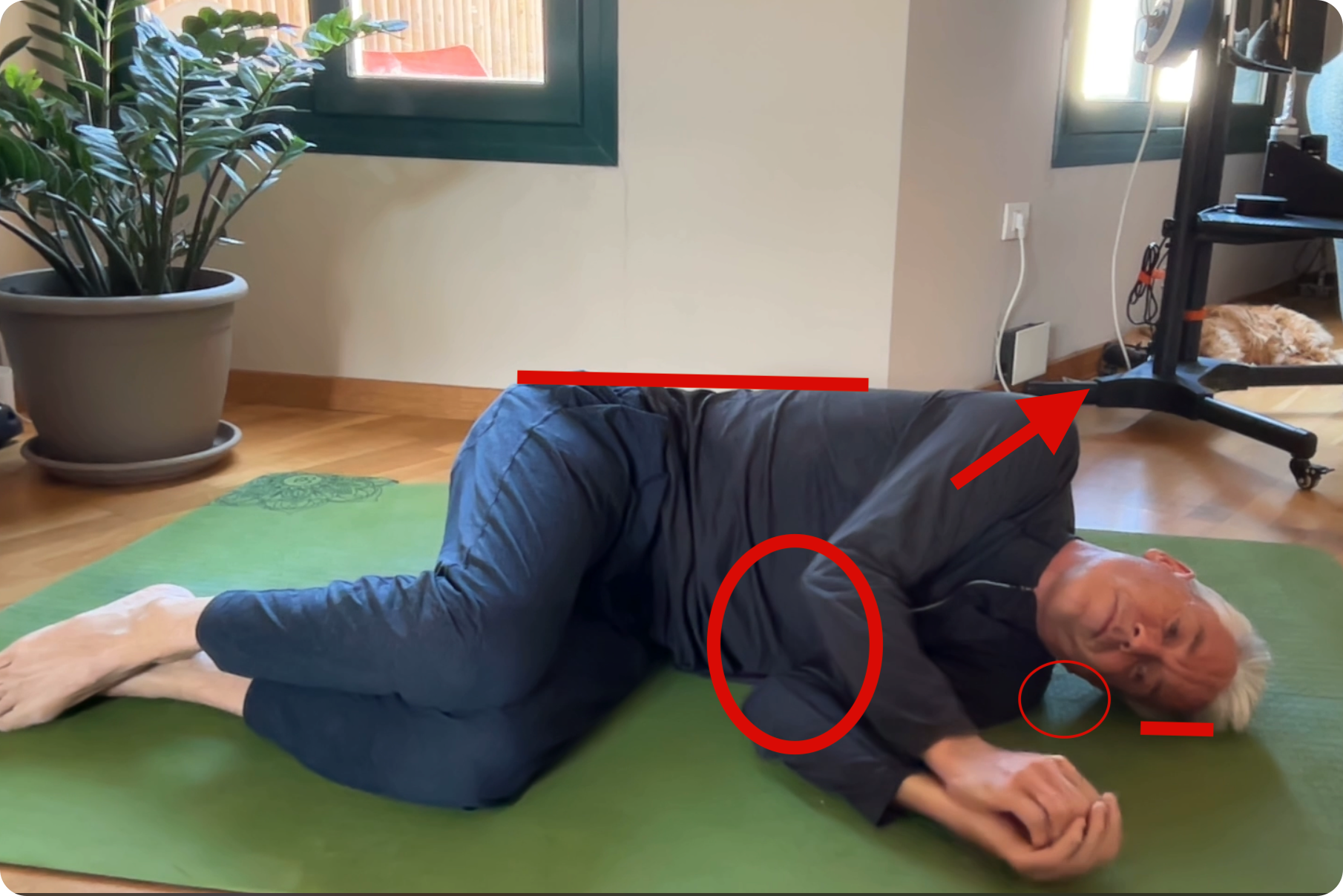
Even on the right side, internal edges appear. The two knees touching each other — uncomfortable. The scaphoid bones of the feet — uncomfortable. One elbow resting on the other — uncomfortable. It's no longer the broad surfaces of contact that are speaking. It's the bones, the hard points, the internal contacts that the first two days couldn't reveal.
The body is no longer reading in binary — comfortable versus uncomfortable. It reads in gradients. The right side has its own friction zones. Comfort is not the absence of sensation — it's a finer, more precise sensation, one that begins to differentiate what was once an undistinguished mass.
On the left side, nothing has changed structurally: the shoulder lifts the body off the floor, the head only touches at the top, there's no room for the arm. But a new conflict emerges. The right shoulder — the one on top — wants to release. It wants to yield. But it has no space to do so. The body is asking for something the architecture cannot provide. This is exactly what the newborn never experiences: it doesn't yet have the rigidity that prevents release.
Breathing confirms everything. On the right, the belly is in contact with the floor, the breath descends — but the release produces a torsion in the left flank, between the pelvis and the ribs. When one layer releases, the layer beneath appears. This is an underlying rotational pattern that couldn't manifest before.
On the left, nothing has moved: the belly doesn't touch the floor, the breath stays in the outer edges of the chest. Impossible to regulate.
Grasping is done on the right side. Opening and closing the hands dissociates from the rest of the breathing — the entire body stays steady while the hands work. The deep meditative state from Day 2 doesn't return today. The sound bath is there — a low-frequency hum with a continuous AUM in the background, recreating the fetal acoustic environment. But the state varies from day to day. That's normal. The baby doesn't experience every day the same way either.
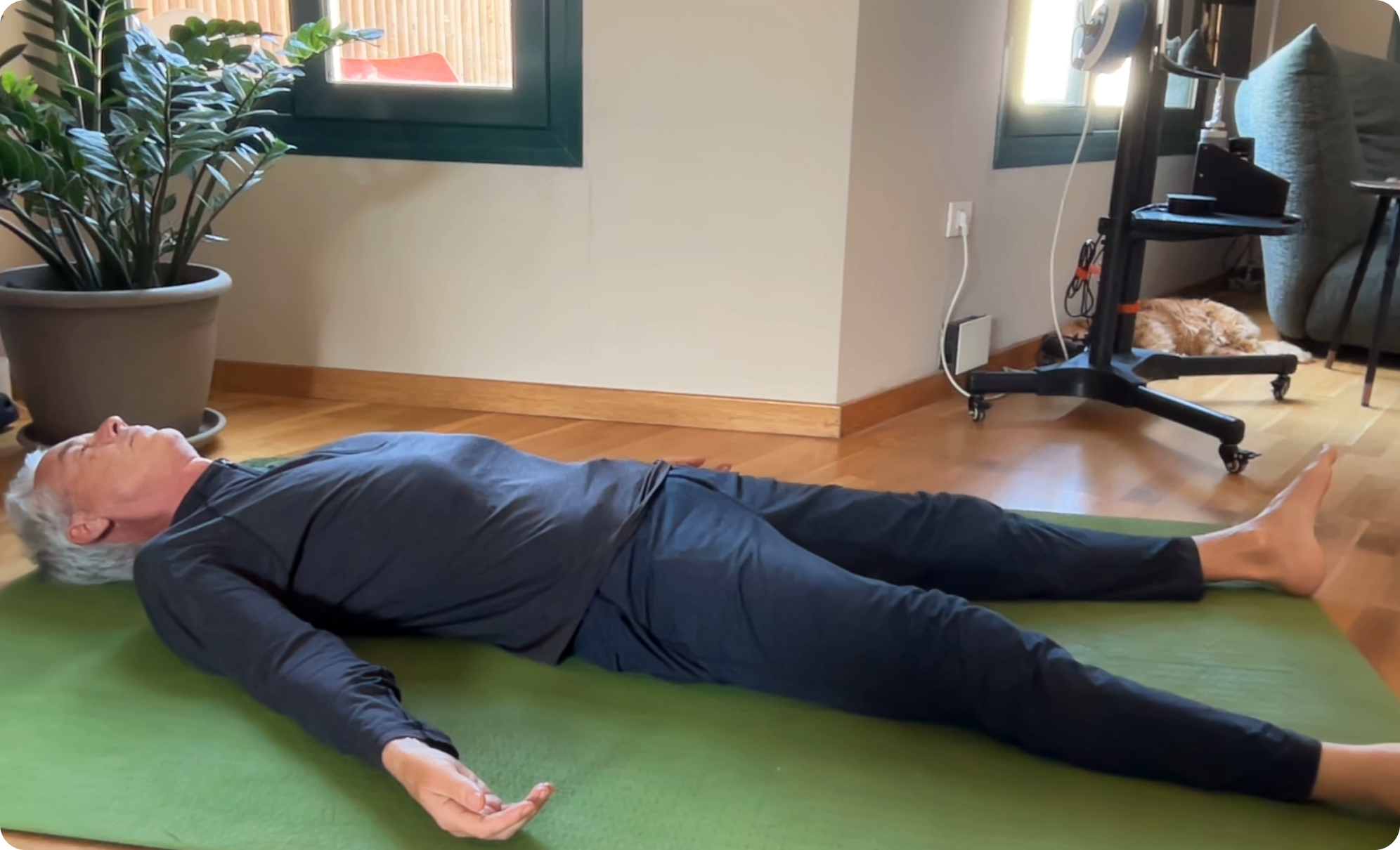
On the back, clear progress. The head is less heavy, less pulled to the left. The lumbar curve is reducing. The contact surface is increasing — you can feel it on either side of the spine, with a clarity that wasn't there before.
But the neck still won't yield. When looking straight up, the gaze goes behind and above — not to the ceiling. The cervical curve is too large. The neck maintains an extension that resists contact with the floor. The lower body yields first. The neck will yield last.
Adi — Resistance
Today, the body no longer flees in a direction. It refuses to begin.
From the very first moment of the session, an inner resistance settles in. Not a physical resistance — a resistance of the entire being. Wanting it to be over before it has even started. The sound bath is there — the low frequencies, the AUM in the background — but nothing gets through. The nausea returns, like on Day 2. She has to calm herself mentally, control her breathing, just to keep from stopping altogether.
And then the oscillation begins. Either she fights to continue, or she falls asleep. There's no space between the two — no neutral observation zone. The body swings between active refusal and loss of consciousness, never finding a midpoint.
The strangest part: when she wakes between two sleep phases, the body is no longer there. No bodily sensation. Not heaviness, not the melting of Day 1 — a pure absence. The body has disappeared from the field of perception. As if consciousness reignites in a void. This is a state the newborn lives in permanently — it hasn't yet built the body schema that allows it to feel itself continuously.
Relief comes on the back. Immediate. Much better than the day before. The transition from fetal position to lying on the back releases everything that was locked. The right leg is more open than the left — more pronounced external rotation. On Day 1, the left side was the comfortable side in fetal position. The asymmetry expresses itself differently depending on the position: fetal comfort on the left, greater openness on the right when supine. These aren't contradictions — they're different expressions of the same postural pattern.
And then two changes. The head isn't heavy today. For the first time in three days, the skull doesn't sink, doesn't melt. Something has shifted in the body's relationship with gravity at the level of the head. And a pressure appears on the chest — a weight on the sternum that feels good. Not oppressive — comforting. A weight that anchors. This is the principle of swaddling in the newborn, of the weighted blanket, of the embrace. After three fetal phases marked by resistance and loss of consciousness, the back finally offers a contact that the body reads as safe.
What we take away
Three days, three strategies. Day 1: the body flees downward — sleep, face melting, parasympathetic drift. Day 2: the body flees upward — nausea, restlessness, the sensation of being held upside down. Day 3: the body no longer flees in a direction. It refuses to begin. The resistance is there before the first movement. Three days, three forms of avoidance — and all of them say the same thing: lying still in fetal position brings something up that the nervous system would rather not feel.
Two modes of relating to the same exercise. Christian refines his perceptions — he moves from binary reading to gradient reading, he perceives internal edges, underlying torsions. He maps. Adi crosses through. Christian meets his architectural limits — the rigidities built over 56 years. Adi meets hers differently: resistance, nausea, loss of consciousness, and then the relief of the back. Two bodies on the same path, but not at the same pace or through the same doors. The baby has neither of these obstacles. It is what both are converging toward.
The body discovering itself. In Christian, the internal edges of the knees, the elbows, the feet — invisible on Day 1, perceptible on Day 3. The torsion in the left flank. The shoulder that wants to yield but can't. The neck that resists. In Adi, the body disappearing from its own perception, and then the back finally offering safety — the pressure on the chest, the head that no longer weighs. Two ways of arriving at the same place: the body doesn't free itself. It reveals itself layer by layer.
← Back to journal