Christian — The Nervous System Distracted
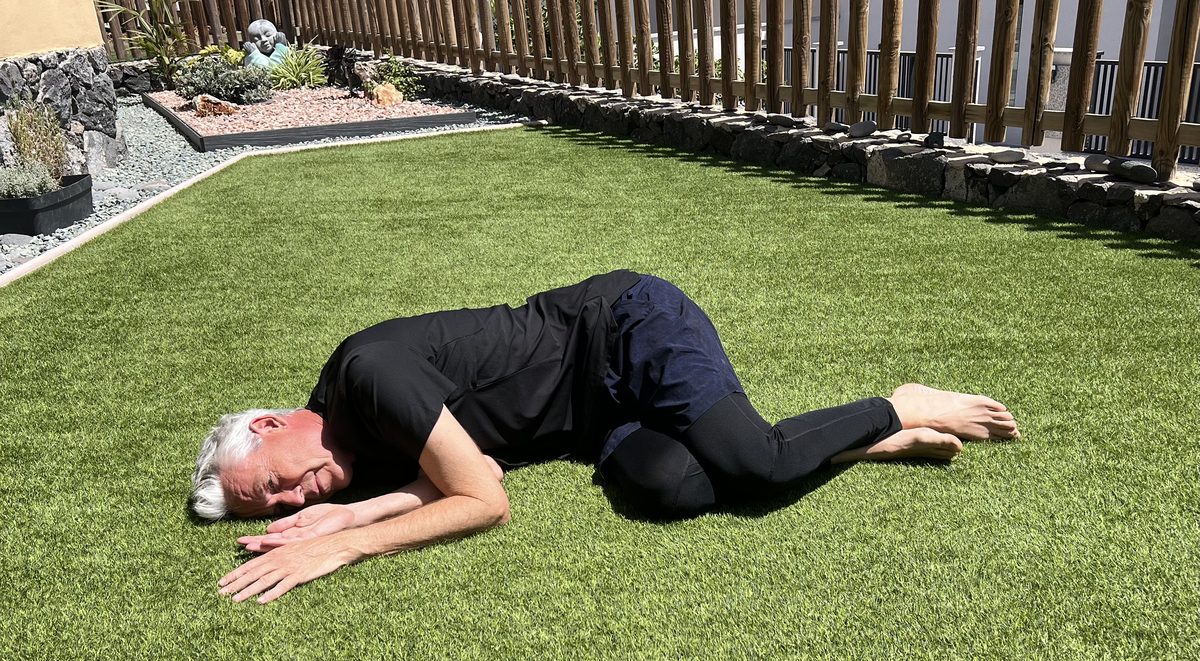
For the first time, the session takes place outside. In the garden, on a synthetic grass surface slightly tilted from head to feet — a slope designed to drain rainwater. The sun is at its zenith, it is 2pm, not a cloud in the sky. The wind is strong. The sea, a hundred metres away, is rough, and waves crash against the cliffs.
A flood of sensations
It is an avalanche of sensory information that changes practically every second. Heat comes from below — the sun has warmed the surface the body is lying on. Heat comes from above — the sun beats directly on the skin. But this heat from above varies with the intensity of the wind, which at times is very strong. And there is the sound — waves breaking against the cliffs, an irregular, unpredictable rhythm.
The nervous system is constantly pulled in different directions. Solicited from one side, then another, then another. Which means that the contact with the ground, the position, comfort or discomfort — all of that fades into the background. There is no room for the nervous system to obsess over a single point. Everything moves, all the time.
The two sides
The position on the right side is not the same as on the left — as the day before. The limbs arrange themselves differently. But the left side is becoming increasingly comfortable compared to previous sessions. Breathing too, on both sides, has become completely acceptable.
The question
The only limit is the sun. When the wind drops and the sun strikes the skin directly, it is intense. There is a form of apprehension — it would not be good for one's health to stay exposed without protection.
And this is where the question arises. Why change the surface and the setting? To expand the capacity for experience through the senses? But that is still the adult speaking. Is it an intellectual challenge? A desire to test something new?
The baby would not ask this question. It is not yet autonomous — it would experiment, but with the help of its parents. It is the parents who stimulate the stages, who change the conditions, who offer new surfaces. And this is why in the twelve-month process, the role of the parents is so important: they are there for support and stimulation.
What we retain
Moving outside transforms the session from the inside. For ten days, the nervous system had a limited number of variables: the surface (floor, sofa, bed), gravity, breathing, bony edges. Outside, the variables explode — heat from below, heat from above, variable wind, the sound of waves. The nervous system can no longer fix on a single point. It is forced to process all information in parallel, which frees the body from the obsession with comfort or discomfort.
When the nervous system is sufficiently stimulated, comfort and discomfort cease to be the subject. It is not that the body is more comfortable outside — it is that the nervous system is too busy to care. The heat, the wind, the sound create a sensory bath that drowns the question of comfort in a flood of broader information. This is exactly what the infant experiences: it does not ask whether it is comfortable. It is too busy receiving the world.
The question "who decides to change the surface" is the right question at the right moment. After ten days, Christian has enough experience to wonder whether the choice to go outside is a choice of the body or a choice of the mind. The adult wants to expand the experience — that is the intellect at the controls. The baby does not choose: the parents change the conditions. In this project, the role of the parent is precisely that — to stimulate, to vary, to offer — so that the body does not have to decide with the mind.
Adi — Sensory Pleasure
Same surface, same garden. Adi lies down on the synthetic grass in the sun, outside for the first time. The wind is strong. Heat rises from the ground below, the sun strikes the skin from above, and the wind modulates it all — sometimes cool, sometimes absent. Waves crash against the nearby rocks.
The combination
What strikes Adi is the combination. Not a single dominant element — everything arrives at once. The warmth of the ground beneath the body, the warmth of the sun on the skin, the wind passing over, the sound of the waves. It is a new experience in this context, and it is very pleasant. Adi is not searching for anything, not correcting anything. She is simply there, lying down, receiving the warmth, the sounds, the sensations on her skin. And it is a pleasure.
The back
Adi woke up this morning with more back pain than usual. The pain remained present throughout the session. But it did not prevent the pleasure. The pain was there, the sensations were there, and the sensations took over — not by denying the pain, but by occupying the nervous system enough that the pain was no longer the main subject.
After the session, Adi feels relaxed, tired, and well.
What we retain
When sensory pleasure is sufficient, pain loses its centrality. Adi's back was hurting before she began. It hurt throughout the session. But the bath of sensations — warmth, wind, sound — created a context so rich that the pain could not take control. It is not that the pain disappears. It is that the nervous system is too busy processing other things to give it full attention. This is exactly the same mechanism as in the infant: a crying baby can be soothed by a change in stimulus — a new sound, a different touch, a movement. The pain has not changed, but the nervous system has found something else to do.
Sensory pleasure becomes the ground — no longer the exception. On Day 9, Adi described a moment of pure bliss when sound came out of her throat. But that was a flash — a precise instant tied to a specific experience. Today, pleasure is no longer a moment. It is the fabric of the entire session. Lying in the sun, feeling the wind, hearing the waves — without searching for anything, without analysing anything. Pleasure is no longer triggered by an event. It is there because the body is there, and the body is receiving. Comfort is the absence of discomfort. Pleasure is the presence of well-being. The body is no longer merely tolerating the position — it is enjoying it.
← Back to journal