Christian — The Wave and the Block
On the floor, same approach as the day before: no search for comfort or discomfort. Settle, that is all. Right side to start.
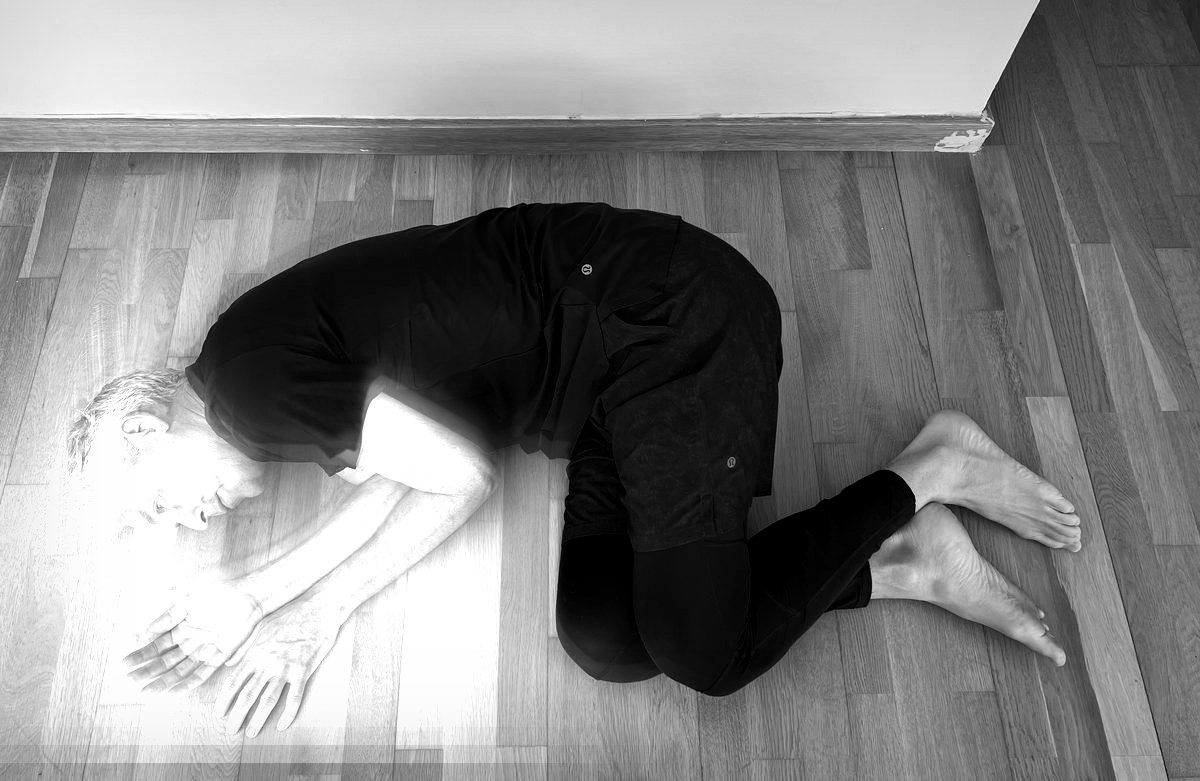
Right side — the shockwave
The first thing that arrives is the breathing. With each inhale-exhale, a shockwave propagates through the upper body — from the pelvis all the way into the head. The body moves significantly with each cycle. This is not a micro-movement. It is a wave that crosses the entire trunk, visible, perceptible, as if the breath had taken possession of the whole structure.
The face — waking from anaesthesia
The second observation extends what had begun the day before with the release of the face. Today, the release is so deep that beyond the sensation of melting wax — already observed on Day 6 — something new appears. The gums, the teeth, the nose: everything is felt as a block. Like that feeling at the dentist's when the anaesthesia begins to wear off. Not numb in the usual sense — rather in the waking phase. A release so profound that it produces a sensation Christian had never experienced outside a dentist's chair.
Left side — a completely different position
The left side is very different. Without searching for comfort or discomfort, the body lands in an unexpected position: the left leg, in contact with the floor, is almost fully extended. The left arm is stretched toward the right leg. The position is completely different from the right side, yet with a significant contact surface across the body.
The breathing does not have the same effect: the upper body does not move with the inhale-exhale. But despite this difference, the same facial release is there. The same dental block. The face responds in the same way, regardless of the position of the rest of the body.
The left side remains less comfortable than the right — even without searching, the sensation is not the same.
On the back — the curve flattens
On the back, the release is complete. Christian feels that the curve in the lower back is much less pronounced than usual — the lumbar lordosis flattens toward the floor. The head is much less heavy. The breathing is so released that the body is on the edge of sleep.
What we retain
The respiratory wave that crosses the trunk is the sign that the tissues have stopped resisting. When the intercostal muscles, the diaphragm, and the thoracic fascia are still holding tension, breathing stays local — it moves the belly, sometimes the ribs, but goes no further. When that tension falls away, each breathing cycle propagates a movement from the pelvis to the head. This is not deeper breathing — it is breathing that finally has all the room.
The facial block — gums, teeth, nose — is a release of the trigeminal nerve branches. The trigeminal nerve innervates the entire face. When the facial muscles are chronically contracted — jaw clenched, brow furrowed, lips held — the innervation stays in active mode. When the release reaches this depth, the facial tissues behave as they do after a local anaesthetic: sensation is present but transformed, as if the face were waking up for the first time.
The face releases in the same way on both sides, but the trunk does not respond the same way. On the right, the respiratory wave crosses the entire upper body. On the left, the trunk stays silent. But the face produces the same block sensation. This confirms that facial release is not linked to body position — it is linked to the level of release in the central nervous system. The face liberates independently of the trunk.
The flattening of the lumbar lordosis is the direct response to ten days of release. The curve in the lower back — the lordosis — is maintained by the tension of the erector spinae muscles. When that tension yields, the pelvis tilts and the back flattens toward the floor. This is not a change in posture — it is the disappearance of a tension that was holding the curve. The body lengthens because it is no longer held.
Adi — The Fragility
After the previous day's session, where the chest had opened and the thoracic spine released, Adi wakes up feeling emotionally very fragile. All day long, the fragility remains — sometimes on the verge of tears, without any reason.
The price of liberation
On the sofa, the session is very different from yesterday. The area of the chest and the spine that had provided such a beautiful stretch the day before is today raw, sensitive, bordering on painful at times. On the left side and the right, the spine and the chest are fragile — as if the emotional fragility had translated into physical pain in that same area.
The sparks
And then there is something else. Like flashlights turning on and off in different parts of the body. Small sparks of pain — in the knee, then in the hip joint, then in the neck. They arrive and leave very quickly, in different places. Adi lets it happen. She breathes through the whole experience, lets these small sparks come and go.
What we retain
The emotional fragility of the next day is the exact counterpart of the previous day's liberation. The thoracic spine that opened on Day 9 had released a space that had been held for a long time. What was contained within that tension — and which is not necessarily identifiable as a specific memory or emotion — manifests the next day as fragility. The body opened a door. What was behind it comes out, not as a storm, but as a diffuse vulnerability.
The released area that becomes painful the next day is not a regression — it is a clearing. Yesterday's pleasant stretch and today's raw pain are two phases of the same process. The first phase opens the tissues. The second phase is the local inflammatory response — the body sends blood, attention, sensitivity toward the area that has just moved. This is not a step backward. It is the body repairing what it has just unlocked.
The sparks of pain that travel through the body are the nervous system recalibrating. When a major area releases — the thoracic spine, the chest — the connected myofascial chains react. The knee, the hip, the neck are not random locations: they are relay points along the posterior and lateral chains. The flashes of pain that light up and go out are the nervous system testing its connections, like an electrician checking circuits after repairing the main panel.
← Back to journal