Christian — Abandoning the Postulate
First day of the second week. Second consecutive day on the floor, without music. And from the very start, something has changed. There is no postulate. No imitation of the dog. No ideal foetal position. No instruction. Christian settles onto his right side and observes. Micro-adjustments happen on their own to find the spot on the floor where the body is most comfortable. Without telling himself to extend the arm. Without telling himself to place the left leg over the right. Nothing but observation.
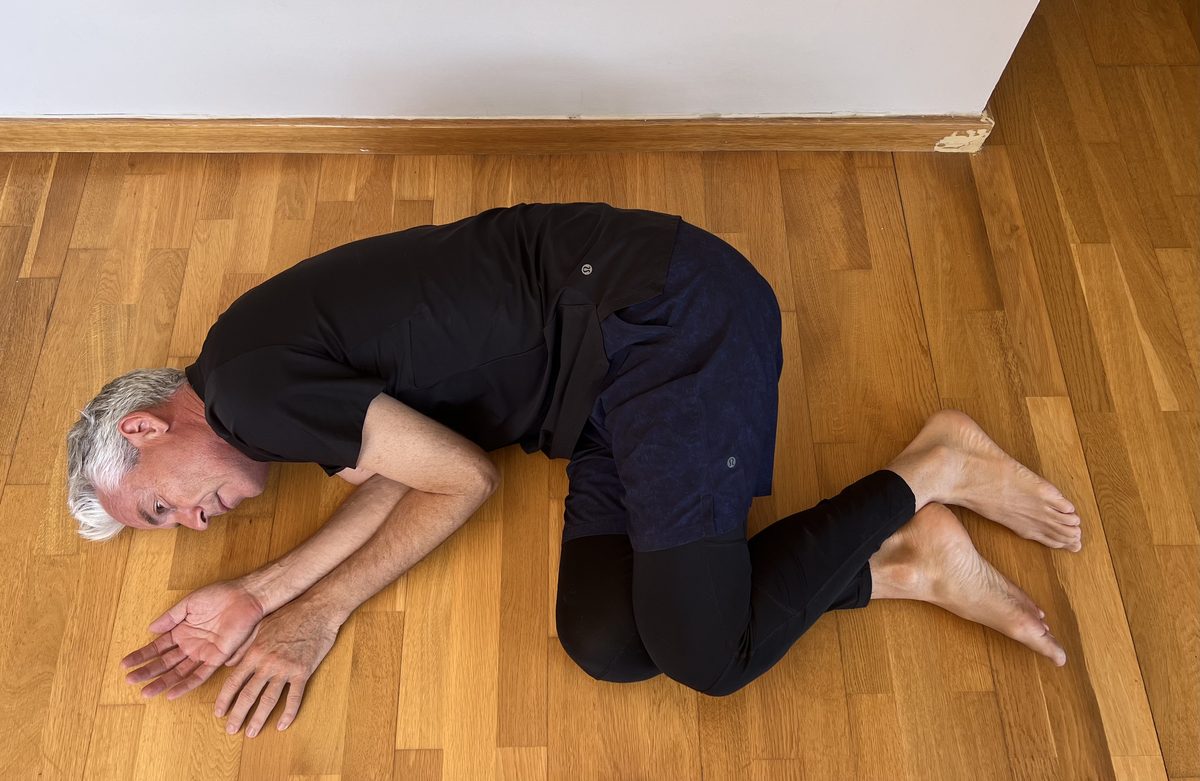
Right side — dissolution
After some time, the position is found. Very comfortable. No discomfort anywhere — not the head, not the shoulder, not anywhere. And this is where the experience shifts. Christian realises he is no longer in the analytical mode. He is not scanning his feet, his knees, the bony edges, the pelvis, the head. He is scanning nothing.
What comes is of a different order. Moments of forgetting. A state between waking and sleeping, fully meditative, where the body's contours disappear. There is no more search for comfort because comfort has become the ground itself. The sensation is that of being part of the universe around him — of the floor, of the space. There is no longer a boundary between the body and what surrounds it. There is no longer a search for contact with the outside. Everything is experienced from within.
Left side — the escape
The left side is entirely different. The contact surface is smaller. But the same process takes hold: micro-adjustments to find comfort, and as soon as comfort is there, the body vanishes from the field of awareness. The bony edges fade, the body's outline ceases to exist.
Except this time, what arrives is not dissolution into space. It is an escape. Christian drifts into an inner conversation with someone he knows. He departs completely. It is only after an indefinable stretch of time that he returns — like that meditator who thought he had spent fifteen minutes on his mountain when in fact he had been there for five hours. On returning, he realises he is on the floor, in a very comfortable position, even on the left side.
On the back — the same shift
In the supine position, the same phenomenon. No sense of the head's weight. No sense of the contact surface. A rapid departure from the physical aspect and from contact with the floor. The body is there, but awareness is no longer in the body — it is inside something much vaster.
And then — the dance
Christian adds something that happened after the Day 7 session. He put on music. He began to dance. And he burst into tears. Not sadness. Exuberance. Pure joy. Dancing without any opinion of himself, just being in the moment. No judgement. No distance. Just movement and the emotion pouring out.
The sensation of Day 8 is the continuation of that moment: being a form of everything inside everything.
What we retain
The absence of postulate is the result of the first week, not an intellectual choice. For seven days, Christian explored positions, surfaces, internal instructions. The body accumulated enough experience for the eighth session to need no framework. The body knows how to settle. It no longer needs to be told how. This passage from instruction to surrender is exactly what the infant lives: at a certain point, the motor patterns are sufficiently integrated for the movement to become spontaneous.
The disappearance of body contours is a marker of deep sensory release. When Manas — sensory perception — has completed its exploration for seven days (scanning, feeling, adjusting, perceiving weight, contact, gravity), there comes a point where the nervous system no longer needs to monitor. The contours fade because there is nothing left to correct. This is not a loss of consciousness — it is a transfer: from external vigilance to internal presence.
The two sides produce two different states, and that is information. Right side: dissolution into space, a sense of belonging to the universe, no boundary. Left side: escape into an inner conversation, a mental journey, loss of the notion of time. The same body, the same floor, but two different responses. This confirms what the first week showed: each side has its own pattern, its own history, and even in deep release, this asymmetry persists — it simply manifests at another level.
The tears after the dance are not an emotion — they are a structural release. A body that dances after a session of deep release is not making an emotional choice. It is liberating what has been unlocked. The sobs of exuberance from Day 7 are not joy in the way the mind understands it. It is the nervous system discharging energy that was held within the layers of tension. This phenomenon is well known in bodywork: when tissue releases, emotion emerges — as laughter, tears, or trembling. It is not psychological. It is physiological.
Adi — The Floating
Same conditions as Christian: floor, no music, second consecutive day on this surface. The beginning is difficult. The usual position — slightly tilted forward on the left side — is not comfortable today. Small adjustments. Then her back toward the floor, gaze to the ceiling: slightly better. But it is not quite right.
And then, suddenly, Adi finds herself in what she describes as a middle position — truly on her left side, not leaning forward, not leaning backward. Just the side. It is comfortable, and she stays there for a long time.
The slow transition
When she decides to switch sides, everything happens in slow motion. Through the back, then slowly toward the right side, settling without much movement, observing where the body lands. The right side immediately finds its position: the lower arm extended in front, the left arm draped over, hand near the neck, palm facing down. Very comfortable, for a very long time.
After a while, pain in the shoulder. A small adjustment, a slight shift backward. Adi finds herself on both sides in this half-side position, without rolling forward or backward. The ribcage releases toward the floor with each breath.
On the back — the floating
When Adi settles onto her back, something new appears. Adi often has difficulty lying completely flat on her back — she needs to bend her knees and place her feet flat on the floor. But increasingly, this flat position with legs extended is becoming comfortable for her.
And today, it is more than comfort. The entire body is very relaxed — open, released. But at the same time, no sensation of heaviness. Instead of feeling the body's weight against the floor, Adi has the impression of floating.
What we retain
The middle position — neither forward nor backward — is a sensory discovery. For seven days, Adi explored positions by leaning slightly forward or backward to find comfort. On Day 8, she discovers that true comfort is in the middle — exactly on the side, with no compensation. The body has explored the extremes and arrives at the centre. This is the same process as the infant who, after oscillating, finds balance.
Christian loses his contours, Adi loses her weight — two paths to the same place. He feels part of the universe, she feels like she is floating. The words are different, but what is happening in the body is the same: the nervous system stops monitoring gravity. There is no longer a need to hold, to correct, to feel where one is. The body has released enough for the floor to disappear beneath you — or for you to disappear into the floor.
Louella — The Colours
Louella is very tired. In her room, she puts on her headphones, settles onto the bed and lets Erykah Badu wrap around her.
She may fall asleep. What she knows is that slowly, she begins to feel her body disintegrating. Like dust. She is out of her body — only three points of contact remain: the feet, the palms of her hands, and the face against the bed.
Held without tension
At first, Louella feels completely relaxed. It is when she finds herself on her back that she feels the comfort — she feels her curves in the bed. She feels held. Carried.
Between the shoulder blades, a pressure has settled in — pleasant, like something finding its place. And in this state of comfort and relaxation, with the music, the desire to dance arrives. But the body is too released to move a single muscle. So the dance happens in her head. Louella sees herself dancing in her mind, on her back, cradled by the music. The movement is there, but it is not physical — it is visualised.
The colour
And it is there, carried by the sound, that Louella begins to perceive colour coming out of her. Not an image, not a thought — a sensation of colour emanating from the body. It is a very beautiful experience.
What we retain
Three people, three different dissolutions. Christian loses his contours and merges into the universe. Adi loses her weight and floats. Louella loses the continuity of her body — only three points of contact remain — and what emerges is colour. Each nervous system finds its own path toward deep release. And each path tells something about the person: Christian inhabits the volume of the room, Adi frees herself from gravity, Louella lives in movement and colour.
← Back to journal