Today is the first day. We lie on the floor in fetal position. We close our eyes. We surrender all our weight to gravity.
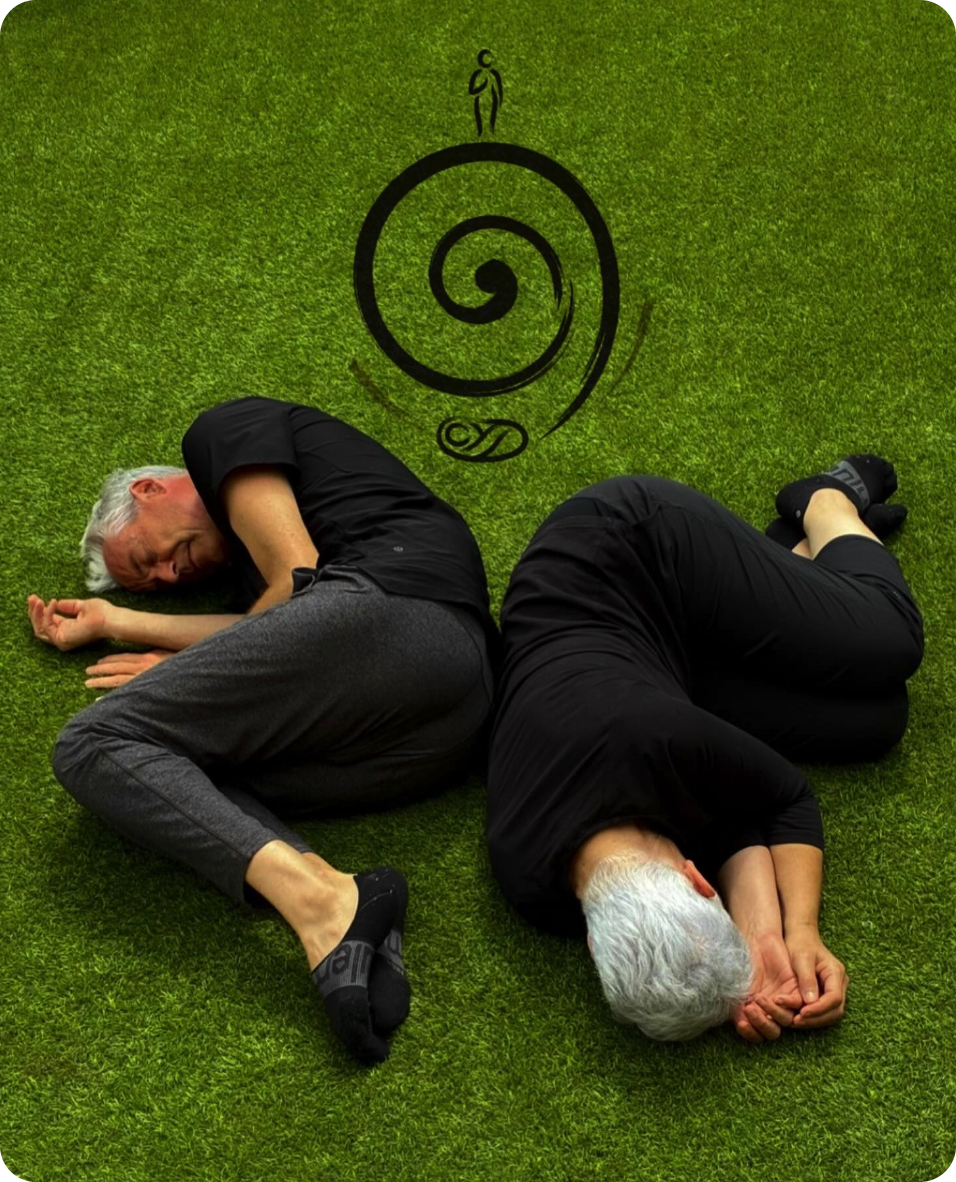
And we discover that our three bodies don't tell the same story at all.
Christian — The explorer
I start on the right side. My cheek touches the floor, the ribs settle, the belly finds its place — everything is fluid. The breath descends into the belly and rises into the ribs. I feel good.
I turn to the left side. Everything changes. The shoulders resist, the head ends up on the forehead instead of the cheek, the ribs are hard as edges, the pelvic bones hurt. The belly is completely lifted off the floor. The breath stays stuck at the top, in the lungs.
Two sides of the same body. Two completely different realities.
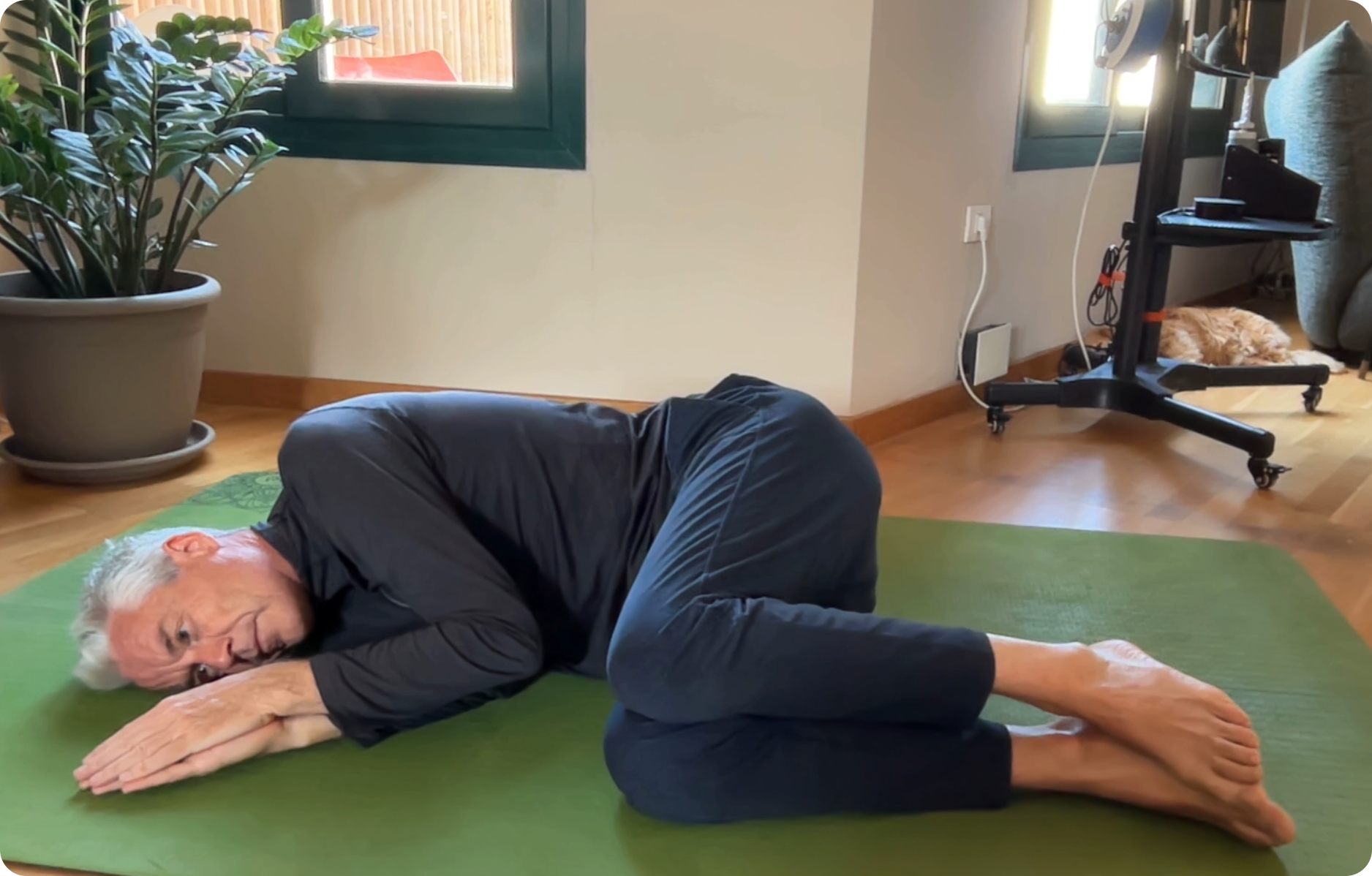
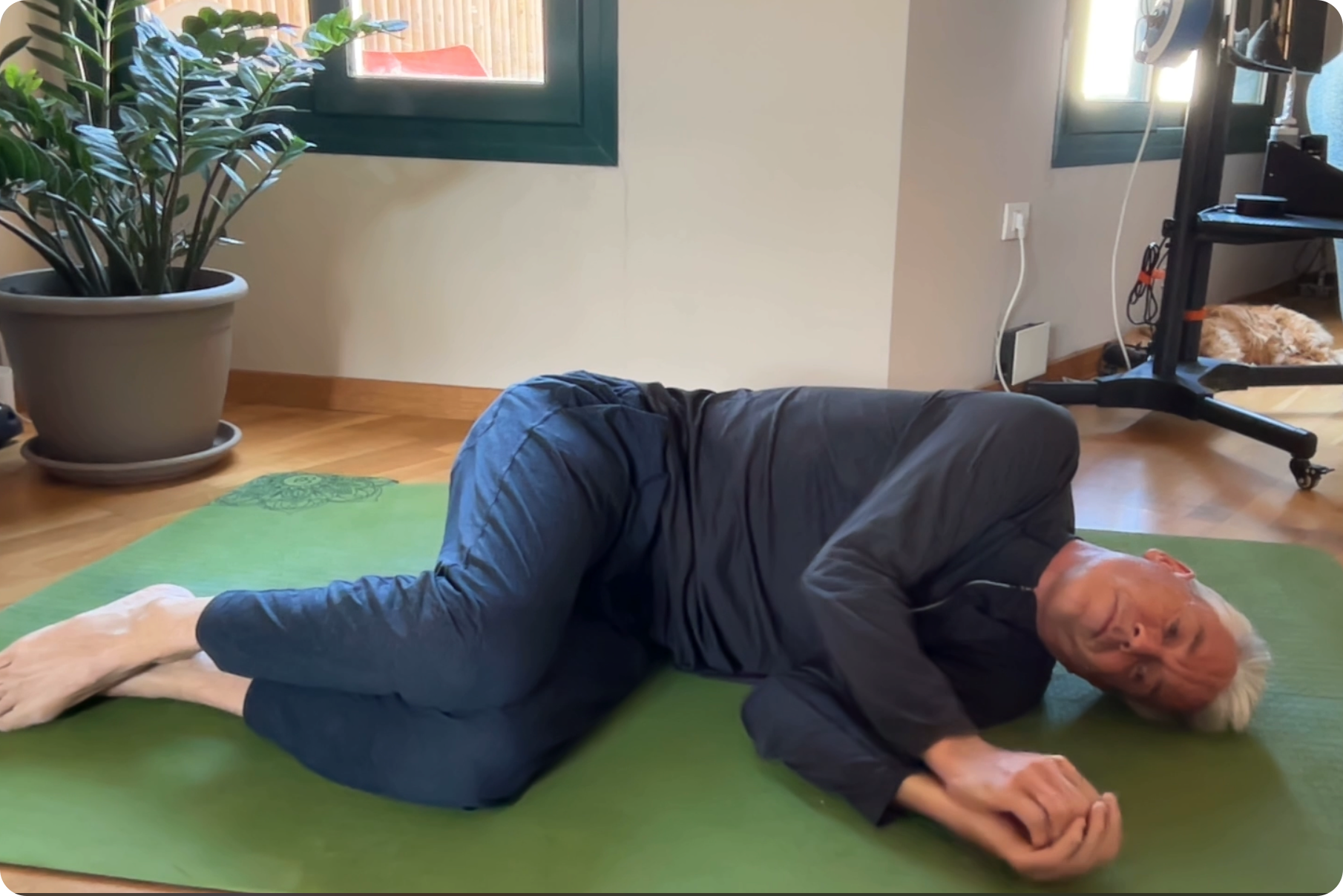
The most surprising moment comes with the hands. When I play with opening and closing my fingers — that grasping reflex every baby possesses — something happens that I hadn't anticipated: the entire rest of the body releases. Focusing attention on the hands frees tension everywhere else. The baby knows this instinctively. We've forgotten it.
On my back at the end of the session, my head pulls slightly to the left — the same side that resists in fetal position. The body doesn't lie. It shows, again and again, the same pattern.
Adi — The experience
I settle on the sofa for a softer surface. Right side first. And the only thing I hear is my heart. Boom boom. Boom boom. My heart is beating so loud I can't perceive anything else. I need a pillow under my head and another under my leg — nothing rests naturally.
We open the window. Street sounds come in. And strangely, I no longer hear my heart. The breath takes over.
I turn to the left. There — that's my side. I only need support under my head, the rest settles on its own. But my belly starts making an incredible noise. Stomach, intestines — everything gurgles, everything moves. It's distracting, almost comical.
When we move to the hands, I start falling asleep. I drift. No matter how hard I fight to stay awake, my body leaves. And the cold sets in — a cold that comes from inside, not from the room.
The last position, on my back with the blanket, is the strongest. Everything becomes heavy. Incredibly heavy. Especially my face. I have the sensation that my face is melting into the surface, dissolving. The breath is entirely in the belly — barely a movement in the chest.
That's all for today. But it's already a lot.
Louella — Pure sensation
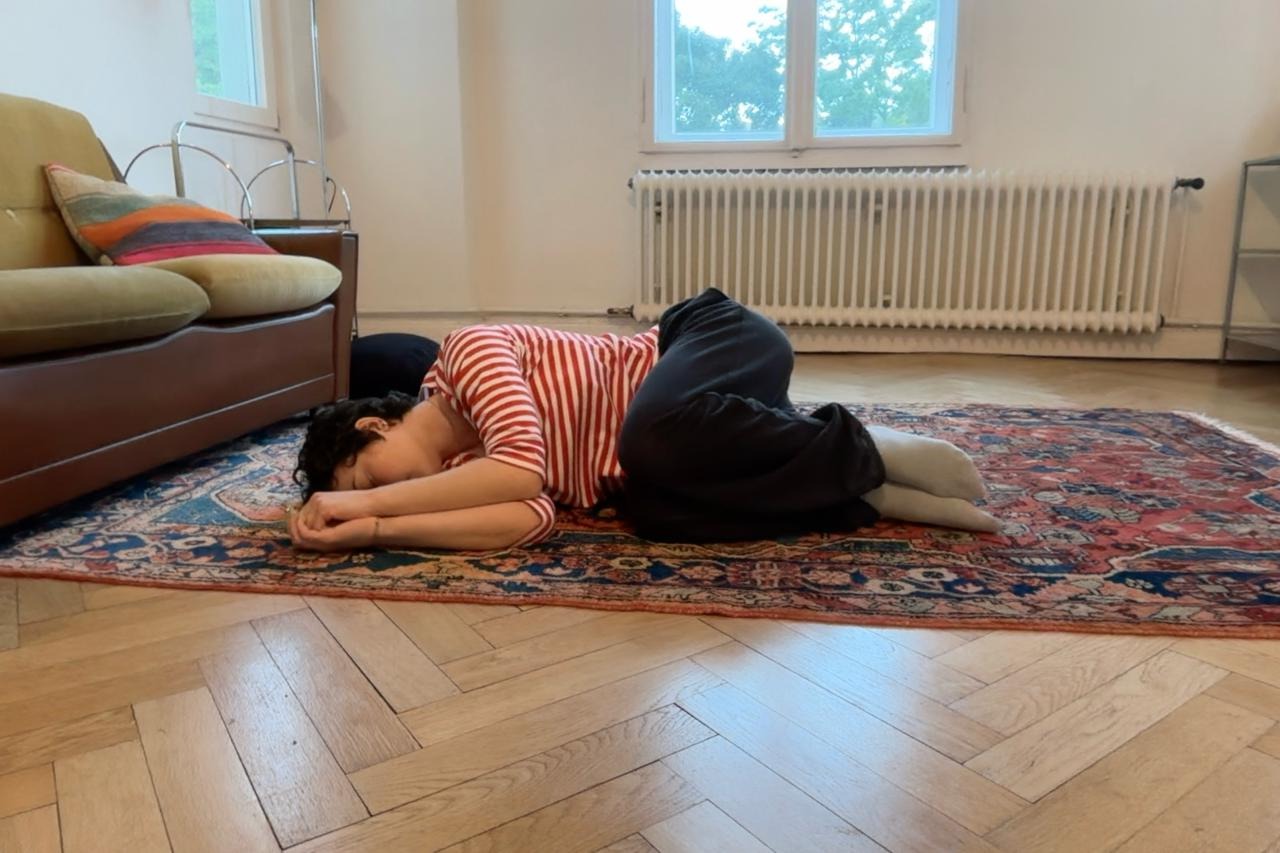
Berlin. Alone, on the floor. The same exercises, 3,000 kilometers away.
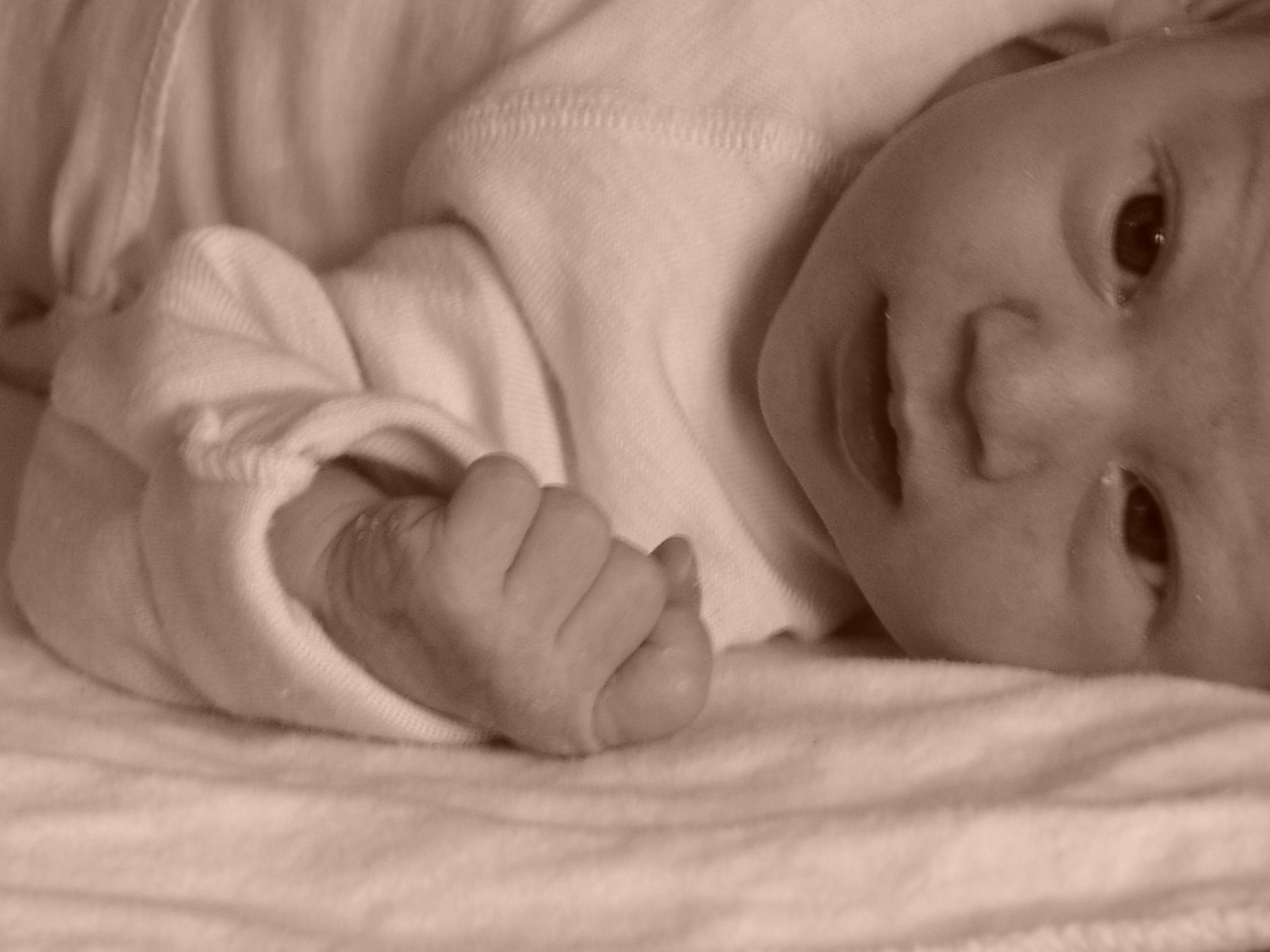
From the very first moment in fetal position, something striking: arms resting one on the other, impossible to tell apart. The legs merge too. The entire body reduces to a single mass with no internal boundaries. Like a ball of wax in the sun, melting into itself. This is exactly what the newborn experiences — it doesn't yet know the parts of its body as distinct. Louella, at 20 years old, recovers this sensation in the very first exercise.
During grasping with eyes closed, the hands become enormous. Disproportionate. Impossible to measure. The brain, deprived of visual reference points, recalculates the body's proportions from internal sensations alone. This is body schema distortion — what the baby lives with permanently.
On her back, the entire body opens. A sensation of a flower blooming. The hips open, everything becomes light. Except the head. The head is very heavy, much larger than the rest of the body. It sinks into the floor while everything else floats.
Another detail: the left hip is more open than the right. The left toes are closer to the floor. An asymmetry inscribed in the structure, to follow over 12 months.
What we take away
The first day reveals an inverted symmetry. Christian is comfortable on the right side, Adi on the left. Louella's left hip is more open. Three bodies, three patterns.
The body speaks differently depending on the person. Christian perceives surfaces of contact, supports, bone tensions — the body read from the outside. Adi perceives her heart, her intestines, the drift toward sleep, the melting of the face — the body read from the visceral interior. Louella perceives the fusion of limbs, the distortion of proportions, the flower that opens — the body read through pure sensation. No intellectual education has formatted her perception. What she describes is the closest to what the baby actually experiences.
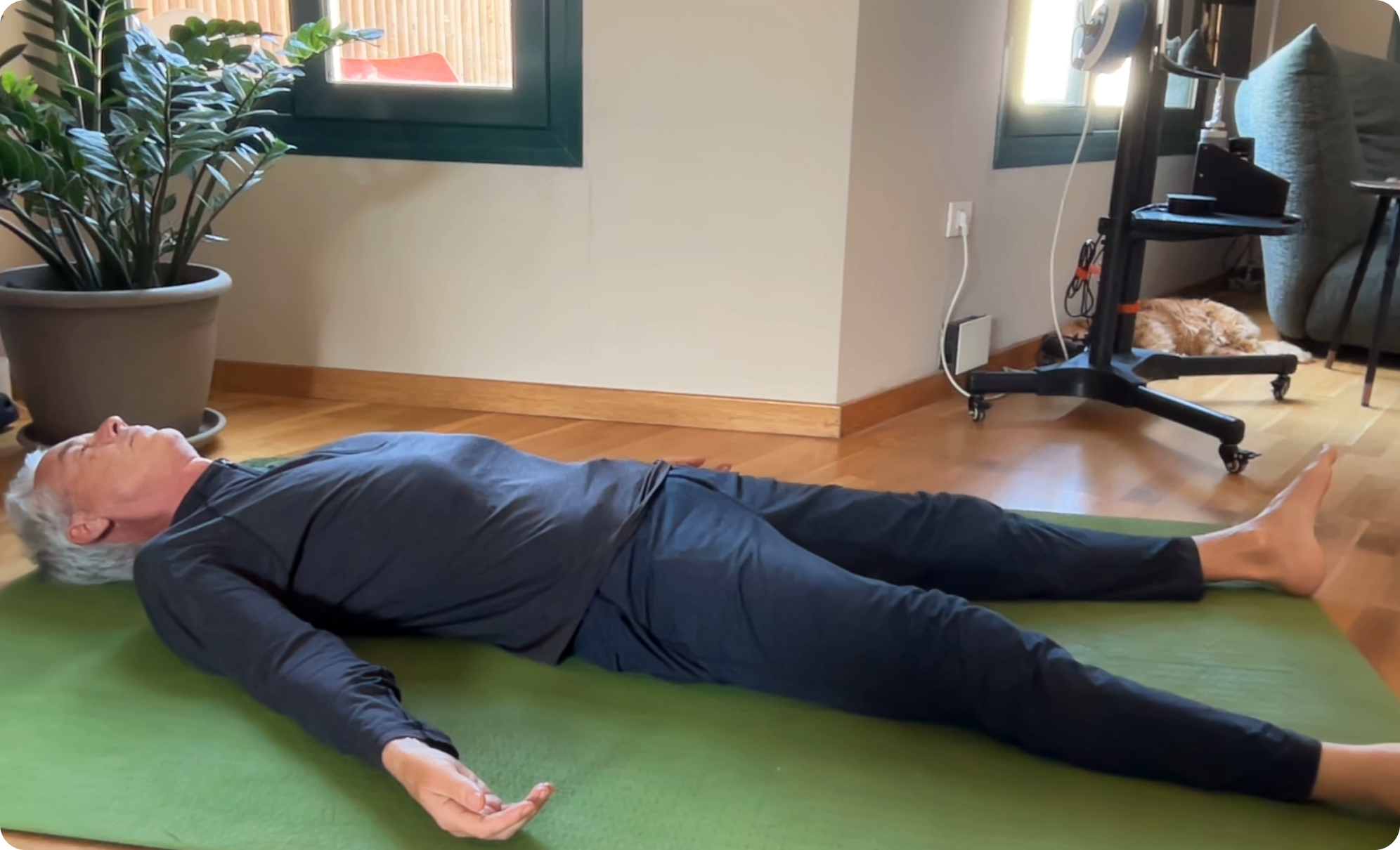
One thing unites all three: the heavy head. Christian — the head pulls to the left. Adi — the face melts into the floor. Louella — the head sinks while everything else floats. The skull is the last point of the body to yield. It is also the first to carry the weight of everything the mind has accumulated.
We're only just beginning. 364 days remain.
← Back to journal